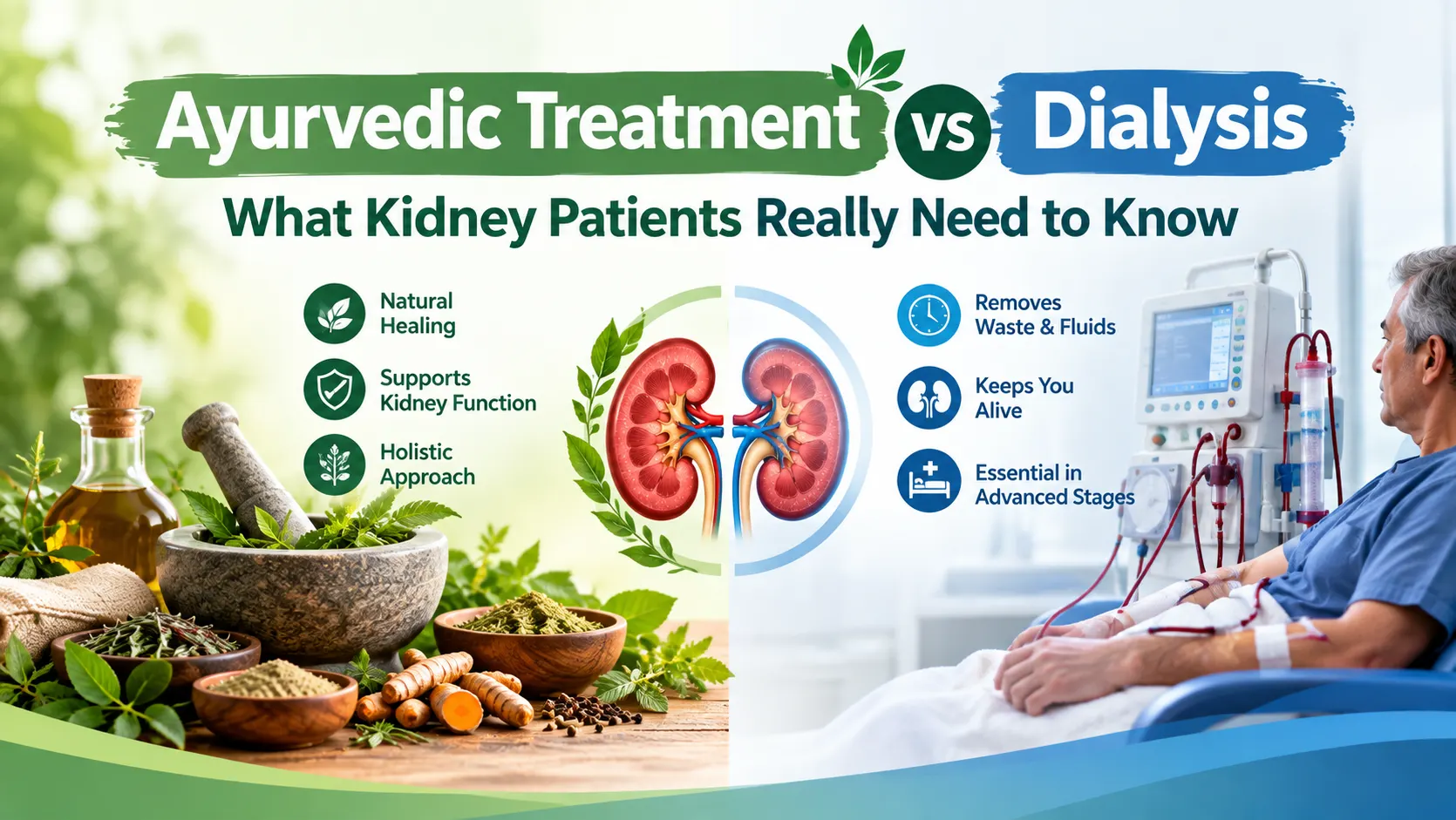

Short answer: dialysis isn't a "lifestyle choice" you swap out for herbs; it's the machine that keeps you alive once your filters have mostly stopped working. Ayurvedic treatment shines earlier in the journey, as a supportive, natural sidekick, not a replacement for a life-saving procedure. If you came here hoping for a neat "pick one" answer, I'm about to disappoint you a little; but stick around, because the real answer is far more useful.
I get why people search "Ayurvedic Treatment vs Dialysis" at 1 a.m., panicking, half-convinced that some herb from their grandmother's kitchen shelf can undo decades of damage. I've been there with a family member, phone in one hand, kadha in the other, googling things I could barely pronounce. So, let's have the conversation nobody has with you calmly; without the fear-mongering, without the miracle-cure salesmanship, just plain honest talk.
Wait, What Even Is CKD?
Chronic Kidney Disease (CKD) is basically your body's filtration system slowly losing its filter-y powers. Waste and fluid that should be flushed out start hanging around like an unwelcome houseguest who "just needs the couch for one more week." Doctors track this through a number called eGFR (estimated Glomerular Filtration Rate); the lower it drops, the more advanced the disease.
Here's the part people skip: CKD has five stages, and treatment looks wildly different depending on which one you're in. Stage 1 or 2? Lots of room to work with diet, herbs, and lifestyle. Stage 5 (kidney failure)? That's when dialysis or a transplant genuinely becomes non-negotiable, because at that point the kidneys are functioning at less than 15%, and no herb on earth can substitute for that.
So Where Does Ayurveda Actually Fit In?
This is where kidney disease Ayurvedic treatment gets interesting, and where I'll be very upfront with you: Ayurveda isn't magic, and it isn't useless either. It sits comfortably in the "supportive care" lane, especially in the early-to-mid stages of CKD, or as a companion to conventional treatment (with your nephrologist fully looped in, not blindsided).
Ayurvedic practice looks at the body holistically: diet, digestion, stress, sleep, the works; rather than chasing a single lab number. Several formulations used in this tradition are considered natural kidney treatment options aimed at reducing inflammation, supporting urine flow, and easing symptoms like swelling or fatigue.
Best Herbs for Kidney Disease (The Usual Suspects)
If you've spent any time in Ayurvedic circles, these names will sound familiar:
-
Punarnava (Boerhavia diffusa); literally means "the one that renews," used traditionally for its diuretic and anti-inflammatory properties.
-
Gokshura (Tribulus terrestris); often paired with Punarnava to support urinary tract function.
-
Varun (Crataeva nurvala); traditionally used to support kidney and bladder health.
-
Ashwagandha; less about kidneys directly, more about managing the chronic stress that quietly worsens most illnesses.
-
Guduchi (Tinospora cordifolia); an immunity booster that also shows up in general detox-support formulas.
A clinical study published in the journal Ayu (Prashanth et al., 2010) compared conventional management with a punarnavadi compound in chronic renal failure patients and found improvements in symptoms and lab parameters in the group receiving the herbal formulation alongside standard care, not instead of it. Another study from the same journal (Patel et al., 2011) followed 100 patients with chronic renal failure receiving Ayurvedic treatment and reported symptomatic improvement in a majority of cases, again as an adjunct approach rather than a solo act.
Worth noting: these are relatively small studies, not massive randomized controlled trials, so treat them as "promising signals," not "case closed" proof. Science is still catching up to grandma's wisdom, one modest study at a time.
The Uncomfortable Truth About Late-Stage CKD
Here's where I have to be the friend who tells you what you don't want to hear. Once kidney function drops to a critical point (advanced Stage 4 or Stage 5), the body simply cannot clear toxins and excess fluid on its own anymore. Left unmanaged, this can lead to dangerously high potassium levels, fluid overload around the heart and lungs, and other complications that herbs, however well-intentioned, cannot reverse in time.
Dialysis, in this stage, isn't competing with Ayurveda for the "best treatment for CKD" title. It's doing a completely different job: it's mechanically filtering your blood because your own filters have essentially clocked out. Delaying it in favor of an all-natural approach at this stage isn't "going natural"; it's gambling with time your body may not have.
This is also the point where certain unregulated herbal products become genuinely risky. Some poorly sourced formulations have been found to contain contaminants (like aristolochic acid in a handful of documented cases) that are actually harmful to kidney tissue. Translation: not all "natural" is automatically safe, especially without a qualified practitioner supervising dosage and sourcing.
Ayurvedic Treatment vs Dialysis: A Quick (Slightly Cheeky) Comparison
|
Factor |
Ayurvedic Support |
Dialysis |
|
Best suited for |
Early-to-mid CKD, symptom management |
Advanced CKD / kidney failure |
|
Speed of action |
Slow and steady, like a tortoise with good intentions |
Immediate; does the filtering job for you, today |
|
Can it replace medical treatment? |
No, plays a supportive role |
It IS the medical treatment at this stage |
|
Side-effect risk |
Low if from a qualified source, higher with random "miracle" products |
Fatigue, cramps, and the joy of a strict diet |
|
Vibe |
Herbal tea and patience |
Machine hum and a good podcast |
|
Needs a doctor's supervision? |
Yes, always |
Absolutely, non-negotiable |
Funny table, serious point: these two aren't rivals fighting for the same job. One's a marathon coach, the other's the emergency response team.
What About Diet and Home Remedies?
CKD patients often deal with digestive troubles too: nausea, appetite loss, and yes, sometimes diarrhea from dietary restrictions or medication changes. While we're on the subject of gentle, home-based support, common diarrhea home remedies like the ORS solution, bland rice-based diets (khichdi, anyone?), and staying hydrated with approved fluids can help settle things down; though anyone with CKD should double-check fluid intake limits with their doctor first, since "just drink more water" isn't universal advice here.
On the broader diet front, Ayurvedic guidance typically nudges toward reducing salt, avoiding excess protein load, and favoring warm, easily digestible meals; a philosophy that actually overlaps nicely with standard renal-diet advice from modern dietitians. Rare moment where ancient wisdom and modern nutrition science are basically holding hands.
So… Which Is Right for You?
Honestly? It depends on where you are on the CKD map, and that's a conversation for your nephrologist, not a blog (even a very charming one). A reasonable, safe approach many patients follow:
-
Get properly staged; know your eGFR and creatinine numbers.
-
In early stages, discuss adding Ayurvedic support (from a certified, qualified practitioner) alongside conventional monitoring.
-
Never stop or delay prescribed dialysis based on herbal treatment alone.
-
Treat any "miracle cure" claim with the same skepticism you'd apply to a stranger's investment tip.
-
Keep your doctor and your Ayurvedic practitioner talking to each other, not working in silos.
Key Takeaways
-
Ayurvedic treatment works best as supportive care in early-to-mid CKD stages, not as a replacement for dialysis.
-
Natural kidney treatment approaches like Punarnava and Gokshura have shown promising (but limited) clinical evidence.
-
Dialysis becomes medically essential once kidney function drops critically low; it isn't optional at that stage.
-
Always source herbal formulations from qualified, registered Ayurvedic practitioners to avoid contamination risks.
-
Diarrhea home remedies and renal-friendly diets can complement treatment but should be checked against fluid/electrolyte limits.
-
The best treatment for CKD is almost always a personalized, doctor-guided combination; not a single miracle fix.
Frequently Asked Questions
Can Ayurveda cure kidney failure completely?
No single Ayurvedic remedy has been shown to reverse advanced kidney failure; it mainly helps manage symptoms and supports early-stage kidney health.
Is it safe to stop dialysis and switch to herbal treatment?
No, stopping prescribed dialysis without medical guidance can be life-threatening, so any changes should only happen with your nephrologist's approval.
What are the best herbs for kidney disease?
Punarnava, Gokshura, Varun, and Guduchi are commonly used in Ayurveda for supporting kidney and urinary health, especially in earlier CKD stages.
Can Ayurvedic treatment and dialysis be used together?
Yes, many patients use Ayurvedic support alongside dialysis for symptom relief, as long as both practitioners are aware of each other's treatment plan.
Are Ayurvedic kidney remedies backed by scientific studies?
Some small clinical studies, like those published in the journal Ayu, show promising symptom improvement, though larger trials are still needed for stronger proof.
Disclaimer
This blog is for general informational purposes only and is not medical advice. Ayurvedic and conventional treatments for kidney disease should only be started, combined, or stopped under the guidance of a qualified nephrologist and registered Ayurvedic practitioner. Please consult your doctor before making any treatment decisions.