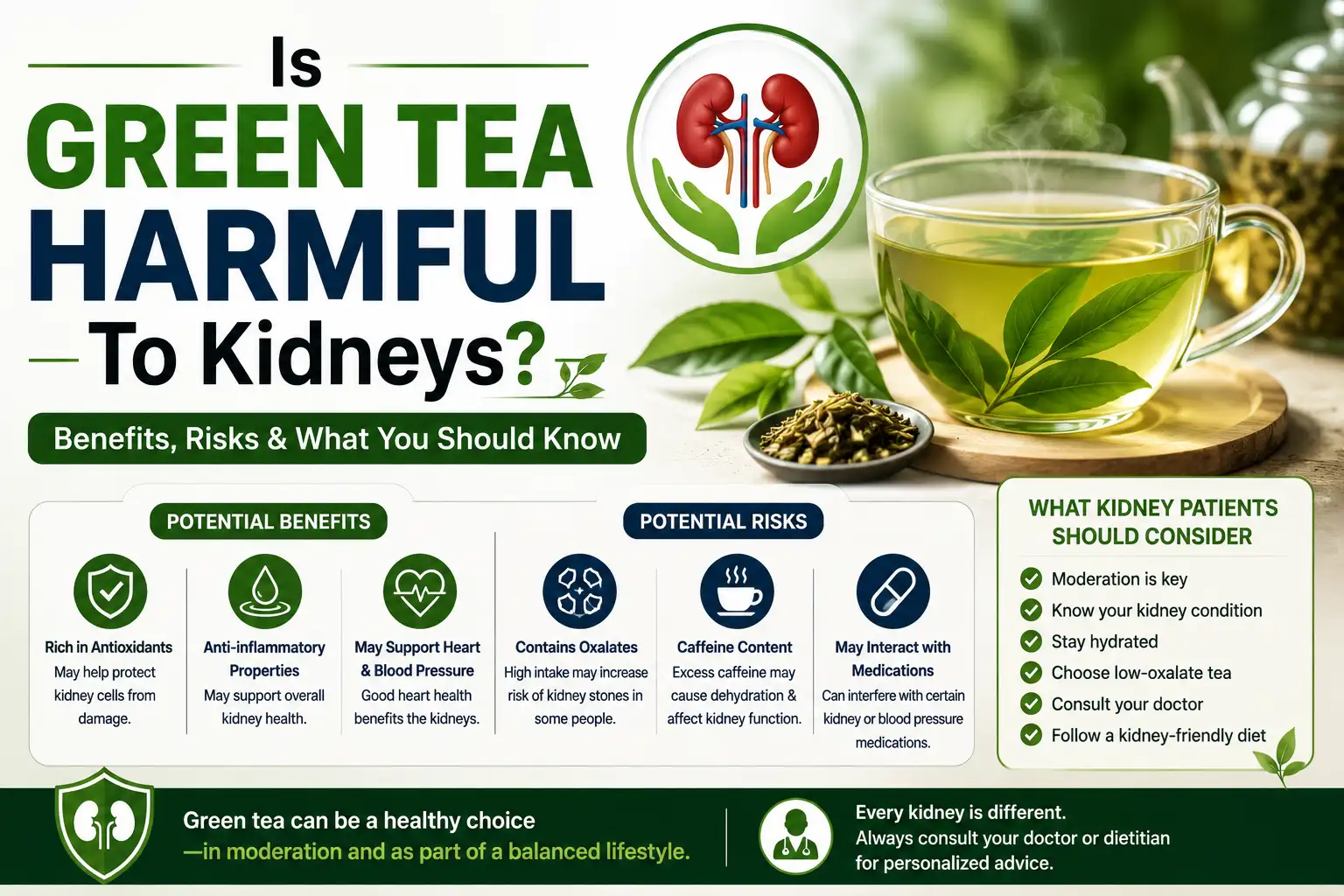

Quick answer, right off the bat, no scrolling required: no, your daily cup of green tea is not secretly plotting against your kidneys. The tea in your mug is honestly one of the more low-drama things in your diet; the actual troublemaker, when there is one, is the mega-strength supplement version, not the stuff you're sipping while pretending to read that book you started in January.
Okay, now that the headline anxiety is dealt with, let's actually talk about this properly. Because I've noticed something: every time a food or drink gets even a little bit of a "health halo," half the internet starts treating it like medicine, and the other half starts treating it like poison, and nobody stops to just... check. So that's what we're doing here. No fear-mongering, no "detox tea" nonsense, just what's actually going on.
Why Does Green Tea Even Have This Reputation?
Here's my theory, and you can disagree with me in the comments (kidding, there are no comments; this is a blog). Green tea has this personality of being The Healthy One. It's the friend who does an early morning workout and then casually mentions it three times before noon. So, people assume anything that's "intense" must be hiding a catch somewhere.
And look, there IS a catch; it's just not where most people think it is. The worry usually comes down to three things people mix up constantly:
-
It has caffeine in it, and caffeine gets blamed for basically everything from anxiety to bad sleep to, apparently, organ damage
-
It has oxalates, and oxalates get linked (fairly) to stone formation
-
Concentrated green tea extract pills have actually caused documented harm in a handful of real cases
That third one is the important bit. And it's also the bit that gets flattened into "green tea bad for kidneys" headlines, which honestly does the whole plant a disservice.
What Actual Research Says (Not Just Vibes)?
I went digging through the studies instead of just trusting my gut, because my gut has been wrong about things before (looking at you, that "healthy" granola with 40 grams of sugar per serving).
A Monash University trial had ten healthy volunteers drink three cups of green tea a day for four weeks. Researchers tracked creatinine, urea, the whole filtration-rate situation; and at the end of it, nothing budged in a bad direction. Renal function stayed put, completely unbothered.
Then there's a randomized controlled trial that went further and looked at people who already had diabetic nephropathy; basically, renal damage caused by long-term diabetes. Not exactly a low-stakes group to test on. Participants drank two to three cups daily for 12 weeks, and instead of things getting worse, their cholesterol and blood sugar markers actually improved, with renal function holding steady throughout.
The Guangzhou Biobank Cohort Study, a big population-level piece of research out of China, is a little more cautious; it says we don't have rock-solid, long-term proof that tea protects renal function in totally healthy people. Fair enough, science likes being careful. But it also points out that several smaller human studies found tea catechins relaxed blood vessels and lowered oxidative stress markers in people who already had renal issues.
And animal studies back this up too; one study on diabetic rats found green tea extract actually improved markers of tubule damage, and another looked at contrast-media-induced injury (the kind that can sometimes happen after certain medical scans) and found that green tea pretreatment reduced the creatinine spike compared to untreated animals.
So, put plainly: at cup-of-tea doses, the research just isn't backing up the "it's harming your organs" story. If anything, it leans mildly helpful, especially for people already dealing with some renal or metabolic stress.
So Where Did This Whole "Harmful" Idea Even Come From?
Here's the actual twist, and it's a good one: it's not the tea. It's the tablet.
When you brew a cup, you're getting a fairly gentle, whole-leaf amount of catechins, sitting in a cup of mostly water, doing their thing the way it's been doing for centuries. Your body knows what to do with that. It's not new information to your liver or kidneys.
Extract supplements are a completely different story. These capsules concentrate the active compound, EGCG, into doses that can range from 200 mg all the way past 1,000 mg per pill, and people often take multiple a day, frequently on an empty stomach because of "faster results," which is also, unfortunately, when absorption (and potential harm) hits hardest.
A safety review looking at concentrated catechin extracts found that big bolus doses; capsule-style, not tea-style- caused real toxicity in the liver, renal tissue, and a few other organs in lab animals. On the human side, LiverTox, which is run by the NIH, actually lists green tea extract as a confirmed, though unpredictable, cause of liver injury in certain people; often tied to a specific genetic marker rather than just "drank too much."
The European Food Safety Authority put out a report in 2017 flagging that EGCG doses above 800 mg a day could be risky for renal and gut tissue in susceptible people. For comparison, a regular cup of brewed tea has somewhere around 50 to 100 mg of EGCG. You'd need to drink something like 8 to 15 cups back-to-back to even get close to supplement territory, and honestly, at that point your biggest problem is a heart rate that thinks it's training for a sprint.
📞 Get a Kidney Health Consultation – Call Now!
Green Tea vs. Green Tea Extract: A Little Comparison, Because Why Not
|
Thing |
Your Actual Cup Of Tea |
The Capsule From The Supplement Aisle |
|
EGCG per serving |
50–100 mg, relaxed energy |
200–1,000+ mg, way too intense for a Tuesday |
|
Effect on renal health |
No harm shown in human trials |
Documented risk at high doses (NIH, EFSA) |
|
How people take it |
Slowly, with breakfast, like a normal person |
On an empty stomach, hoping for shortcuts |
|
Personality |
The friend who reminds you to drink water |
The guy in the group chat selling "miracle" pills |
|
Backed by |
Small but real human studies |
Case reports involving actual liver injury |
Quick Word On Kidney Stones
I want to address this separately because oxalates genuinely do matter if stones are your thing. Tea as a category has a mild association with stone risk because of oxalate content; but here's the part people skip: black tea has meaningfully more oxalate than green tea does. Some research even suggests green tea can lower urinary oxalate excretion in certain situations. So if stones are what's keeping you up at night, green tea probably isn't the one you need to be side-eyeing.
📩 Ask a Kidney Expert (Free 10-Min Consultation)
If You Already Have Renal Concerns
If you're managing an existing condition, the honest answer is: talk to your doctor before changing anything, and don't let a blog (even a good one, wink) replace that conversation. That said, a lot of people in this situation start looking into gentler, whole-body support alongside their regular treatment, and this is usually where Ayurvedic treatment for kidneys enters the picture; it leans toward slow, supportive care instead of aggressive fixes.
A solid natural kidney treatment approach usually combines diet changes, better hydration habits, and specific herbs known for supporting fluid balance and filtration. A properly designed kidney Ayurvedic treatment plan typically looks at the whole person rather than isolating one organ: digestion, stress levels, sleep, the works.
Some of the most commonly mentioned best herbs for kidneys in Ayurveda are punarnava, gokshura, and varuna; all traditionally used to support healthy fluid balance. But herbs aren't magic, and they're definitely not a swap-out for your existing treatment. Anyone exploring the best medicines for kidney patients, herbal or otherwise, should be doing it with a doctor or Ayurvedic practitioner in the loop, not solo, because interactions with existing medication are a very real thing.
The Non-Dramatic Bottom Line
If you're a fairly healthy adult who has two or three cups of green tea a day because you like it, or because it's part of your little afternoon ritual, or honestly even just because the mug is cute; the science just does not support the idea that you're quietly wrecking your filtration system. Some studies even point the other way. The actual thing worth being cautious about is the concentrated extract pills, taken in high amounts, without medical supervision, often on an empty stomach.
So keep drinking your tea. Just don't treat the capsule version like it's the same gentle drink wearing a fancier jacket.
Key Takeaways
-
Regular brewed green tea, at 2–3 cups a day, hasn't shown harm to renal function in multiple human studies
-
The real risk sits with concentrated green tea extract supplements, not your everyday cup
-
EFSA has flagged EGCG doses above 800 mg/day as potentially risky for renal and gut tissue
-
Green tea has lower oxalate content than black tea, so it's not the main worry for stone-prone folks
-
Anyone with an existing renal condition should check with a doctor before adding herbs or supplements
-
A grounded natural kidney treatment plan combines hydration, diet, and professional guidance; not one single "hero" ingredient
FAQs
Does green tea cause kidney stones?
Not really; it has less oxalate than black tea and may even help lower urinary oxalate levels.
How many cups of green tea are considered safe per day?
Two to three cups is the range most human studies tested and found to be perfectly fine.
Is green tea extract basically the same as drinking green tea?
Not at all; extract capsules are far more concentrated and carry a real, documented risk at high doses.
Can someone with existing renal issues still drink green tea?
Small studies in people with diabetes-related renal damage showed no harm at moderate intake, but check with your doctor first.
Are Ayurvedic herbs actually safe for renal support?
Herbs like punarnava and gokshura are traditionally used this way, but only under professional guidance alongside your regular treatment.
Disclaimer: This blog is written for general informational purposes only and isn't a substitute for professional medical advice, diagnosis, or treatment. Please consult a qualified doctor or Ayurvedic practitioner before changing your diet, starting a supplement, or adjusting any existing treatment plan.