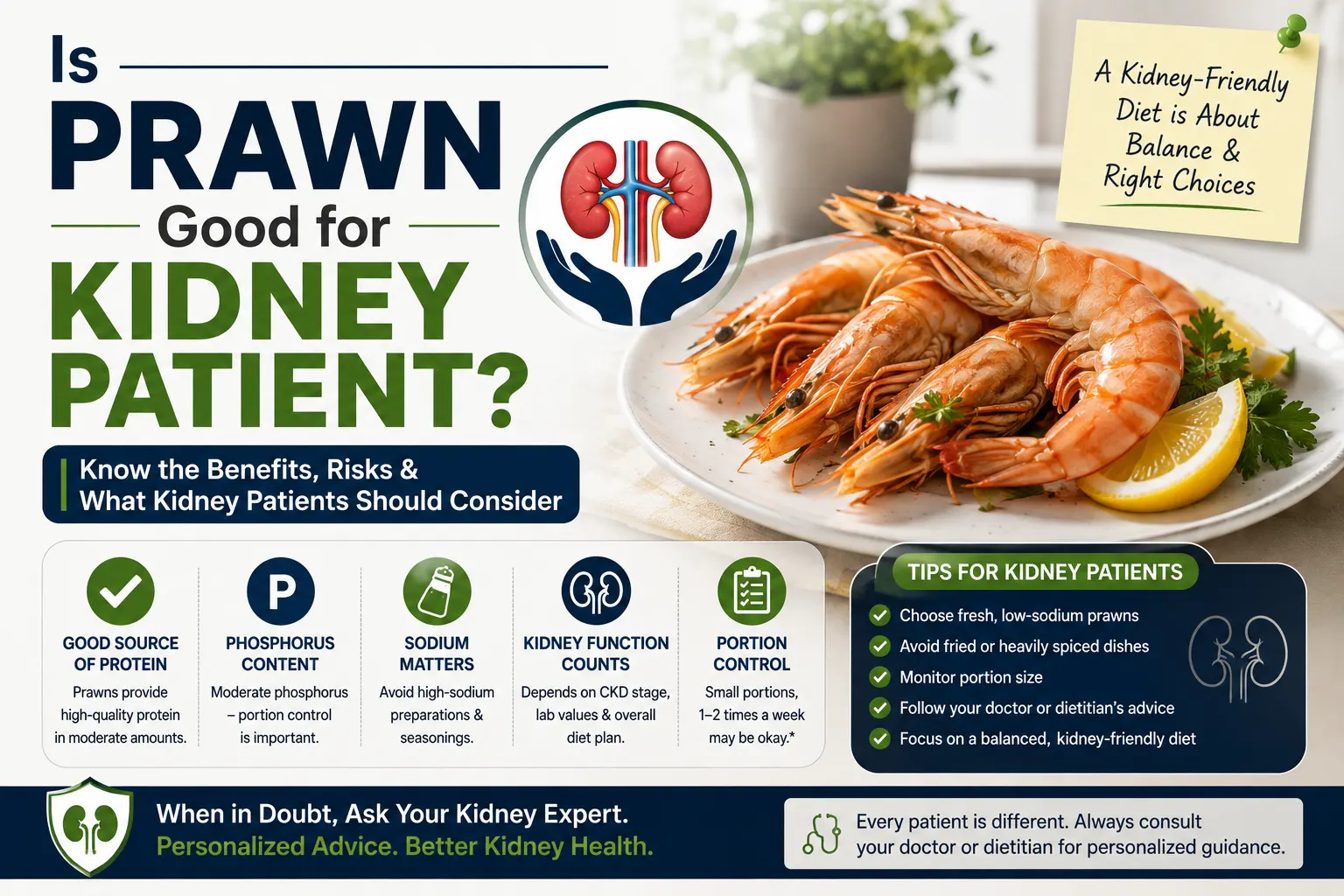

Let's Settle This Once and For All
Yes, prawns are good for kidney patients, but with a catch you're not going to like: it depends on which prawns you buy and how lazy you're feeling about reading the packet. Sorry, no dramatic twist ending here. Just a very "yes, if" kind of answer.
I know, I know. You wanted a clean yes or no. Something you could screenshot and send to your mother-in-law who insists prawns are "poison for the kidneys" (every family has one such relative, don't they?). But nutrition doesn't really do clean answers, especially when there's an organ involved that's already having a rough time.
So, if you've typed is prawn good for kidney patients into Google at some odd hour, standing in front of an open freezer, prawn packet in hand, judging yourself slightly; this one's for you.
Okay, But Why Is This Even Complicated?
Because prawns are one of those foods that refuse to sit neatly in the "good" or "bad" box. They're not a villain. They're also not some magic cure. They're just... a food. A slightly gossiped-about one.
Here's what actually matters when we're talking about prawns for kidney patients:
Protein: prawns have plenty of it, and while the body needs protein, an already-struggling kidney doesn't love processing too much of it at once. Potassium: and here's a genuinely nice surprise; prawns are naturally quite low in it, which is a big win for anyone who's been told to watch their potassium like a hawk. Phosphorus and sodium, though, are where the story gets messy, mostly because of what happens to prawns before they land in your shopping cart.
Which brings us to the part nobody warns you about.
The Frozen Prawn Situation Nobody Talks About
Here's a fun (read: mildly infuriating) fact. Most prawns sold in supermarkets aren't just "prawns." They've been through a little backstage treatment before appearing on the shelf, looking plump and photogenic.
That treatment usually involves something called sodium tripolyphosphate, or STPP for short. Manufacturers use it because it helps prawns hold onto water, meaning they look bigger, weigh more, and survive freezing without turning into rubbery little disappointments.
Sounds like a harmless beauty trick, right? Except this additive brings inorganic phosphorus along with it, and the body absorbs almost all of that; unlike the phosphorus naturally present in food, which your body only partially takes in. On top of that, treated prawns can carry two to four times more sodium than untreated ones. We're talking a jump from a fairly reasonable amount to something that starts resembling a packet of chips more than seafood.
So when people ask Are prawns good for kidney disease patients, the truth is: the prawn was never really the problem. It's the chemistry experiment happening to it before you buy it.
Quick fix, though: ask your fishmonger if the batch is "dry" or untreated. If you're buying the frozen packaged stuff, flip it over and actually read the ingredients (yes, I know, nobody wants to do this in the middle of a grocery run, but it takes ten seconds and saves your sodium levels a headache).
What the Actual Research Says?
This isn't just something I'm making up to sound convincing. There's real science backing this up.
The National Kidney Foundation notes that shellfish, prawns included, can be part of the diet for people on dialysis to help meet their protein needs; though the right amount really should be worked out with a renal dietitian, since shellfish, like any animal protein, still carries phosphorus and potassium that need to be tracked.
There's also an ongoing clinical study, nicknamed the PACK study (Phosphate Assessment in Chronic Kidney Disease Patients Study), being run by researchers at a major U.S. medical center. It's looking at how increasing dietary phosphorus affects blood markers in people with CKD stages 3 to 4, which, in plain English, backs up exactly what we've been saying: it's not just how much phosphorus you eat; it's where it's coming from.
And a separate paper archived in the NCBI's research database found that CKD patients who ate more processed and additive-heavy foods tended to consume noticeably higher amounts of inorganic phosphorus overall. Which, funnily enough, brings us right back to the fresh-versus-frozen prawn debate.
So no, this isn't internet folklore. The research and the fishmonger's advice actually agree with each other for once.
📩 Ask a Kidney Expert (Free 10-Min Consultation)
So How Should You Actually Eat Prawns?
No rulebook here, just some plain common sense dressed up as a food blog paragraph.
Go fresh when you can. If fresh isn't an option, look specifically for prawns labeled untreated or "dry." Give frozen prawns a good rinse under cold water before cooking; it won't touch the phosphorus, but it does knock some surface sodium off. Keep your portions reasonable; think a small handful, not a mountain covering half your plate. Skip the fried, battered versions entirely; batter is basically a delivery system for extra sodium and phosphate additives. And please, for the love of your kidneys, go easy on that prawn cocktail sauce; it's basically concentrated tomato and salt wearing a fancy dress.
And obviously, talk to your nephrologist or dietitian before turning this into a weekly habit, especially if you're on dialysis, since your protein requirements actually go up at that stage, which changes the math a bit.
A Quick Comparison Table (Mildly Judgmental, As Promised)
|
Type of Prawn |
Phosphorus |
Sodium |
The Verdict |
|
Fresh, untreated |
Low-ish |
Moderate |
The responsible one at the family dinner |
|
Frozen, treated with STPP |
High |
Very high |
Says "I'm fine," is clearly not fine |
|
Breaded and fried |
High |
High |
A salt lick in a prawn costume |
|
Cocktail with sauce |
Moderate to high |
High |
Tasty, but your kidneys are side-eyeing you |
|
Grilled, herbs, no sauce |
Low to moderate |
Low to moderate |
Basically, the honor roll student here |
Key Takeaways
-
Prawns for kidney patients can absolutely work, as long as they're fresh, unprocessed, and eaten in sensible amounts.
-
Naturally low potassium is prawns' biggest strength; genuinely useful for anyone watching that number closely.
-
The real risk usually isn't the prawn itself; it's the phosphate preservatives hiding in most frozen packaged prawns.
-
Cooking style matters more than people think; grilled or sautéed beats fried or breaded, every single time.
-
Read labels, ask questions at the fish counter, and get your renal dietitian's opinion before making this a weekly thing.
-
Research keeps pointing to the same idea; it's not just the amount of phosphorus and sodium, it's where it's coming from that decides how kidney-friendly something really is.
Wrapping This Up
So, is prawn good for kidney patients? Mostly, yes; as long as you're choosing fresh over processed, keeping your portions in check, and not burying them under sauce or batter. Prawns really aren't the dietary troublemaker some people make them out to be. They're more like that one ingredient that behaves perfectly well as long as you don't let it get out of hand. Read your labels, ask your dietitian, and there's genuinely no reason a nicely grilled plate of prawns can't sit comfortably in a kidney-friendly diet.
FAQs
Is prawn good for kidney patients on dialysis?
Generally, yes, in fresh and moderate amounts, but it's worth confirming exact portions with your dietitian since dialysis changes protein needs.
Are prawns high in potassium for kidney disease patients?
No, actually, prawns are naturally low in potassium, which works in their favor.
Can frozen prawns be a problem for someone with kidney disease?
Yes, especially if they're treated with phosphate preservatives, which can spike both sodium and phosphorus quite a bit.
How many prawns can a kidney patient eat in a week?
A small serving two to three times a week is a reasonable starting point, though it really varies person to person.
Is prawn good for kidney patients compared to red meat?
Generally, yes, since prawns tend to carry a lower phosphorus load per serving than most red meat.
Disclaimer: This blog is written for general awareness and isn't medical advice. Kidney health varies a lot from person to person, so please check with your nephrologist or renal dietitian before changing your protein, sodium, or phosphorus intake in any real way.