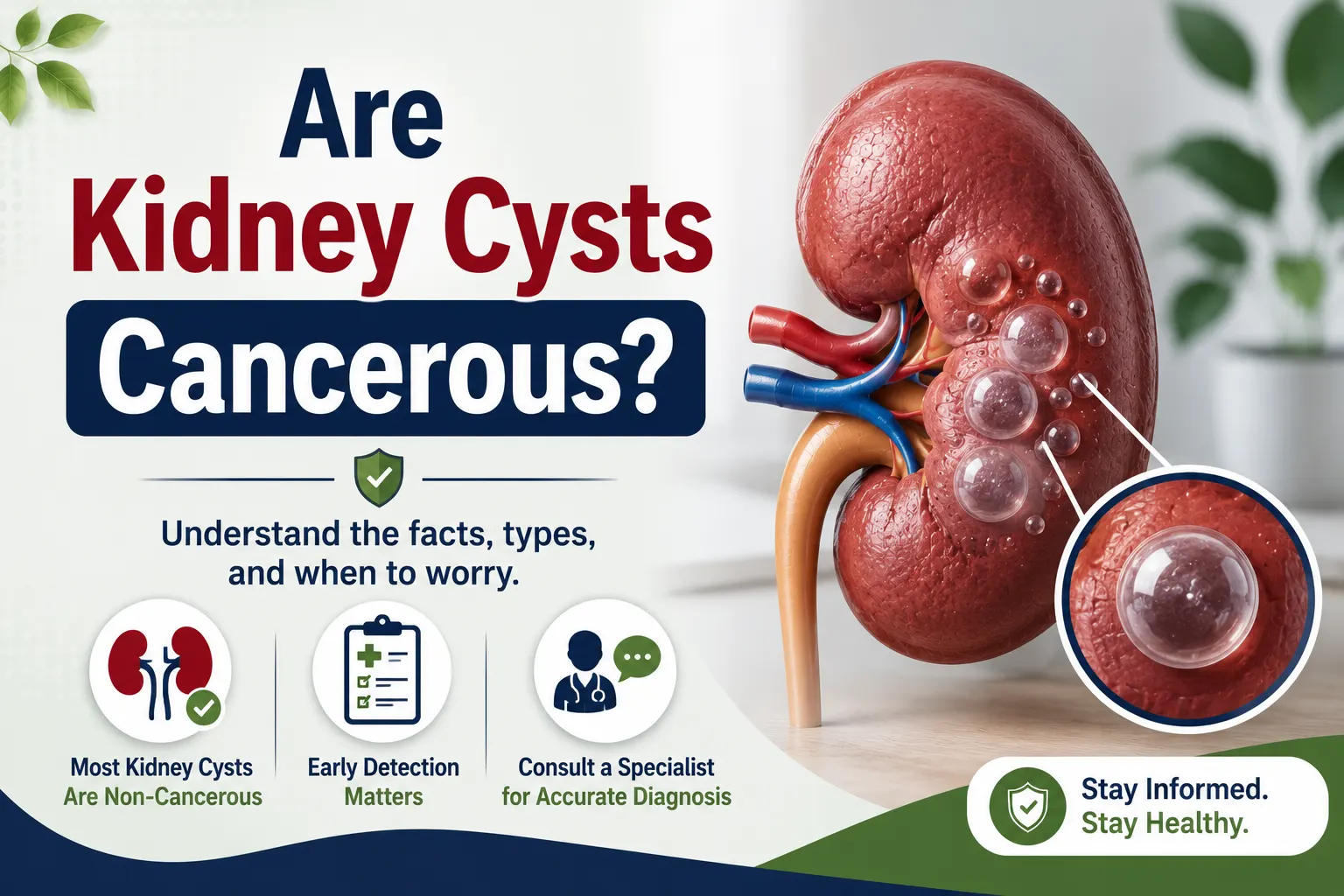

Are Kidney Cysts Cancerous? Here's the Blunt, Non-Scary Truth
Short answer: most kidney cysts are not cancerous; like, the vast majority are just harmless little fluid balloons your kidney decided to grow for no dramatic reason at all. But (and there's always a "but"), a small percentage of them can be complex or suspicious, and those need a proper look before you breathe your final sigh of relief.
Okay, now let's actually talk about it like humans, not like a medical pamphlet nobody reads past the first line.
Wait, What Even Is a Kidney Cyst?
Picture a tiny water balloon chilling inside or on the surface of your kidney. That's basically a simple kidney cyst. Your kidneys are busy little filtration factories, and sometimes, as we age, small sacs of fluid form on them. It's less "uh oh" and more "yep, that happens." In fact, simple renal cysts are so common that a large ultrasound-based study in Japan involving nearly 18,000 people found them in about 9.9% of the population, while a European CT-based study of over 600 patients found simple cysts in roughly 41% of people scanned. So if you've got one, you're in very crowded, very unbothered company.
So When Should You Actually Worry?
This is where doctors bring out their favorite toy: the Bosniak classification system. Named after Dr. Mauricio Bosniak (a radiologist, not a fortune teller, though the system feels a little prophetic), it sorts cysts into categories based on how they look on a CT or MRI scan; things like wall thickness, calcifications, and whether there's weird enhancement happening inside the cyst.
Here's the "cheat sheet" version, minus the medical jargon overload:
|
Bosniak Category |
What It Basically Means |
Should You Panic? |
|
I |
Simple, clear, boring cyst |
Nope, go live your life |
|
II |
Slightly fancy cyst, maybe a thin wall or tiny calcification |
Still mostly a non-issue |
|
IIF |
The "F" stands for Follow-up, not "Fret" |
Keep an eye on it, don't spiral |
|
III |
Getting complicated; roughly a coin-flip risk |
Time to talk seriously with your doctor |
|
IV |
Solid-looking, suspicious features |
This one needs real attention, stat |
As the categories climb, so does the malignancy risk; Category III cysts carry around a 50% chance of being malignant, while Category IV cysts are considered highly suspicious, with close to 100% turning out to be cancerous. That escalation is exactly why your doctor doesn't just glance at an ultrasound and call it a day; imaging modality actually matters here, since Bosniak risk staging is only validated with contrast CT or MRI, not plain ultrasound.
What Actually Bumps Up the Risk?
Not everyone with a cyst is equally at risk of it turning complicated. Certain factors make complex kidney cysts more likely to be linked to cancer, including being male, being younger than 50, having a larger cyst (over 2 cm), a personal history of kidney cancer, higher body mass index, and being of African American descent. None of these are a guaranteed sentence, just things doctors weigh in the background.
Also worth knowing: cysts that pop up because of chronic kidney disease tend to carry a somewhat higher malignancy risk too, which is why doctors sometimes recommend routine monitoring for those specific cases rather than a one-and-done scan.
The "Just Because It Looks Simple Doesn't Mean Skip the Doctor" Point
Here's a fun (read: mildly unsettling) fact: some studies using CT scans found rare malignant cysts even within the "benign" Bosniak I and II categories, which researchers suspect may have happened due to a downgrade in classification rather than the cyst actually being sneaky. Basically, no system is 100% foolproof, which is exactly why routine imaging and doctor check-ins exist; not to scare you, but to catch that 1-in-a-million oddball case early.
Key Takeaways
-
Most kidney cysts are simple, common, and completely harmless.
-
The Bosniak classification (I to IV) is the go-to system for estimating cancer risk based on imaging.
-
Risk climbs sharply from Category III onward; this is where real conversations with your doctor matter.
-
Ultrasound is great for spotting cysts, but CT or MRI is needed for accurate risk classification.
-
Age, gender, cyst size, family history, and BMI can all nudge risk levels up or down.
FAQs
Are kidney cysts usually cancerous?
No, most kidney cysts are simple and totally non-cancerous.
What size of kidney cyst is dangerous?
Cysts larger than 2 cm with complex features carry higher risk, so size alone isn't the full story.
Can a simple kidney cyst turn into cancer later?
It's rare, but doctors still recommend monitoring, especially if the cyst's imaging characteristics ever change.
Do kidney cysts cause pain?
Most don't, though larger ones occasionally cause back or side discomfort.
How are kidney cysts diagnosed?
Usually through ultrasound first, followed by CT or MRI if anything looks even slightly off.
Disclaimer
This blog is for general information and a bit of casual reassurance; it's not medical advice. Kidney health can be genuinely complex (pun intended), so please talk to a qualified doctor or nephrologist about your specific scans, symptoms, or concerns before drawing any conclusions.