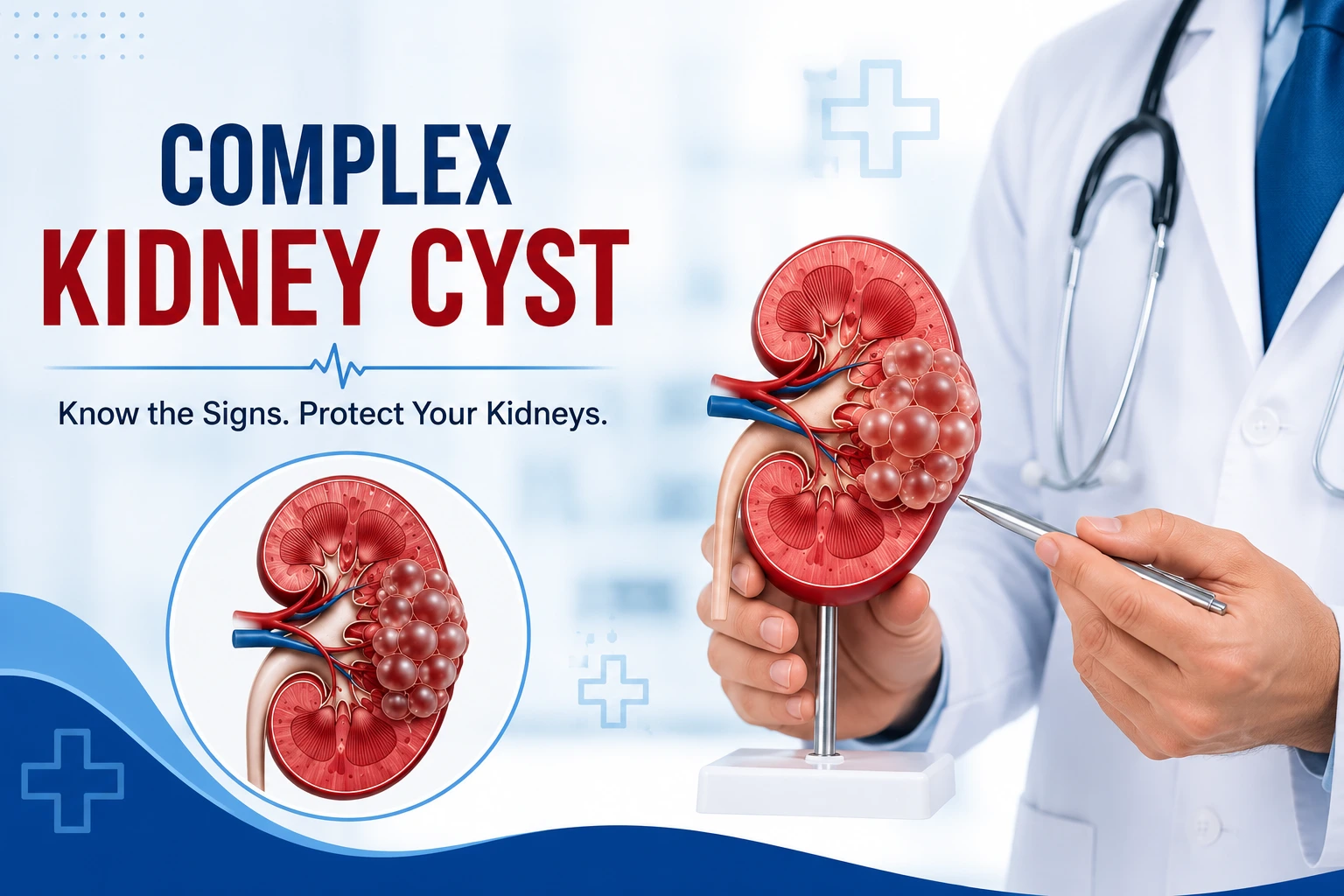

Symptoms of complicated kidney cysts include flank pain, hematuria, frequent UTIs, kidney infection, and abdominal swelling. In the case of large or complicated kidney cysts, additional tests and treatment may be needed.
If you just received the news of having a complex kidney cyst, your brain probably took a terrifying leap into a worst-case scenario. Take a deep breath. Pour yourself a glass of water (your kidneys will thank you), and let’s break down exactly what a complex kidney cyst is, the symptoms it can cause, and what the latest scientific data actually means for your health. No medical degree required; just a friendly, straightforward look at the science.
What is a complex kidney cyst?
To understand a complex kidney cyst, we first have to talk about its much more common, laid-back cousin: the simple kidney cyst.
Think of a simple kidney cyst as a tiny, benign water balloon sitting on the surface of your kidney. It is perfectly round, smooth, thin-walled, and filled with clear fluid. They are incredibly common. If you are over the age of fifty, there is a very high statistical chance you have at least one simple kidney cyst hanging out back there, doing absolutely nothing harmful. They are the medical equivalent of a harmless freckle.
A complex kidney cyst, on the other side of the conversational fence, is a water balloon that decided to get creative. Instead of being a clean, clear pocket of fluid, a complex cyst has extra structural features. It might have internal walls dividing it into smaller sections (called septations), thick outer walls, irregular borders, or solid chunks of tissue inside. Sometimes, it even contains deposits of calcium or signs of active blood flow.
To help doctors make sense of these structural variations without panicking every time they see a bumpy cyst, the medical community relies on a highly standardized classification system.
The Bosniak Classification System
Urologists and radiologists categorize kidney cysts using a system called the Bosniak Classification, which ranks cysts from Category I to Category IV based on how they look on a scan.
-
Bosniak I and II: These are your classic simple cysts or minimally complex cysts. They have razor-thin walls, no solid components, and require zero intervention. They are entirely benign.
-
Bosniak IIF: The "F" stands for follow-up. These cysts are a bit more eccentric; perhaps featuring multiple thin walls or a speck of calcium. They aren’t inherently scary, but doctors like to keep an eye on them over time to ensure they aren't changing.
-
Bosniak III and IV: These are the true complex cysts. Category III cysts have thick, irregular walls or heavy partitions, making it difficult to distinguish them from a benign growth or an early-stage malignancy. Category IV cysts contain clearly defined, solid, nodular components that actively take up contrast dye during a scan, indicating blood flow.
A landmark paper published in the Journal of Urology (2019) titled "The Bosniak Classification of Cystic Renal Masses: Version 2019" completely modernized these definitions. This updated study helped refine how radiologists interpret these fluid-filled structures, preventing unnecessary surgeries on harmless cysts while ensuring that potentially problematic lesions get the precise medical attention they deserve.
What symptoms do complex kidney cysts cause?
Some of the classic symptoms of complex kidney cysts are:
· Dull, Persistent Pain in Your Back or Flank
· Blood in the Urine (Hematuria)
· Frequent Urinary Tract Infections (UTIs) or Kidney Infections
· A Noticeable Lump or Mass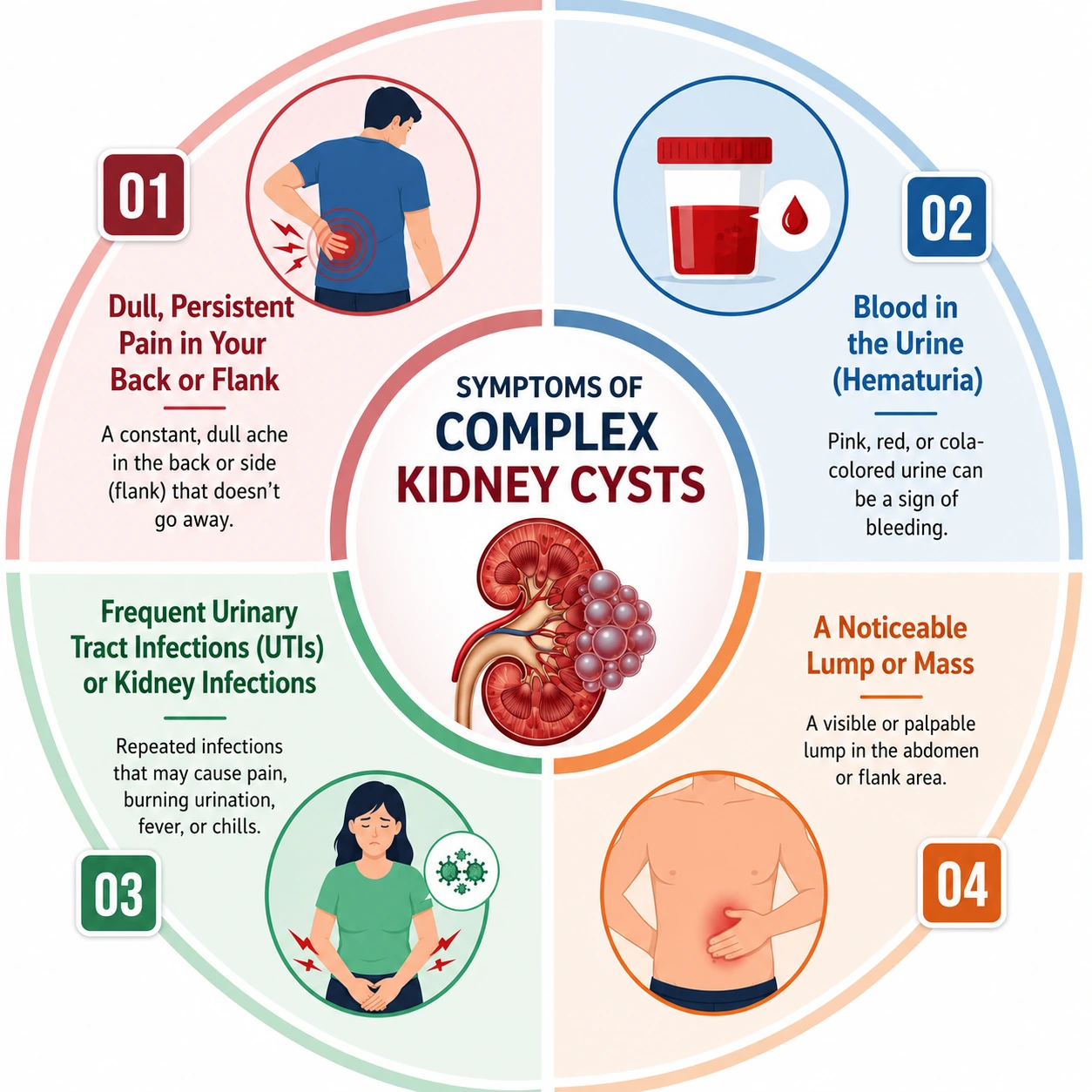
📩 Ask a Kidney Expert (Free 10-Min Consultation)
What the Science Says About Symptoms
It is crucial to understand that having these symptoms does not automatically mean a cyst is dangerous or cancerous. A large, completely benign fluid collection can cause the same physical discomfort as a problematic one purely due to its physical size.
A comprehensive clinical study published in Urologic Oncology titled "Clinical Significance and Management of Complex Renal Cysts" tracked the symptomatic profiles of hundreds of patients. The researchers confirmed that the vast majority of complex cysts remain completely asymptomatic throughout a patient's life. When symptoms do emerge, they are almost always driven by mechanical pressure and size rather than the underlying cellular nature of the cyst itself.
Can a complex kidney cyst become cancerous?
This is the big, looming question that everyone wants answered. The short, scientifically accurate answer is: it depends entirely on the cyst's structural complexity, not the mere fact that it is a "cyst."
A simple kidney cyst (Bosniak I or II) has a zero percent chance of becoming cancerous. It does not mutate, it does not evolve, and it does not turn into a tumor.
A complex kidney cyst, however, is a different story. The structural features that make a cyst "complex," such as thick walls, internal compartments, and solid nodules, are the same visual features that can be caused by a specific type of kidney cancer known as cystic renal cell carcinoma. In these cases, it isn't necessarily that a harmless fluid balloon suddenly turned into cancer; rather, the cancer itself grew in a fluid-filled, cystic pattern from the very beginning.
To put your mind at ease, let’s look at the actual mathematical probabilities across the Bosniak categories, which have been thoroughly documented in American urological literature.
The Breakdown of Risk
According to a highly cited meta-analysis published in the American Journal of Roentgenology, the probability of malignancy correlates tightly with the category of complexity:
-
Bosniak IIF Cysts: These have less than a 5% chance of being cancerous. They are overwhelmingly benign but require periodic imaging just to prove they are staying on their best behavior.
-
Bosniak III Cysts: These carry roughly a 50% chance of malignancy. Because it is a coin flip, urologists treat these cysts with a high degree of suspicion and often recommend surgical intervention or highly specialized management.
-
Bosniak IV Cysts: These have a greater than 85% to 90% chance of harboring cancerous cells. The presence of solid, vascularized tissue means they are treated as localized kidney cancers until proven otherwise.
The good news? Even when a complex kidney cyst turns out to be malignant, cystic kidney cancers are notorious for being exceptionally slow-growing, indolent, and highly treatable. A pivotal long-term study published in the journal European Urology titled "Natural History and Outcomes of Complex Renal Cysts" demonstrated that patients diagnosed with malignant cystic renal masses have an incredibly high survival rate. The study showed that these specific tumors rarely spread to other parts of the body when caught early, making the overall prognosis excellent compared to solid, non-cystic kidney tumors.
How are complex kidney cysts diagnosed?
The following tests are used to diagnose cysts:
· Ultrasound
· Computed Tomography (CT) Scan with Contrast
· Magnetic Resonance Imaging (MRI)
Do complex kidney cysts need treatment?
Finding out you have a complex kidney cyst does not mean you are automatically scheduled for surgery next Monday. The treatment plan is customized based entirely on your specific Bosniak score, the physical size of the cyst, whether you are experiencing pain, and your overall medical history.
Modern medicine has shifted away from an aggressive "cut everything out just in case" approach toward a strategy of careful, tailored management.
The Watchful Waiting Strategy (Active Surveillance)
For cysts classified as Bosniak IIF, the standard American medical protocol is active surveillance. This means you leave the cyst completely alone, but you return for a scheduled ultrasound or CT scan every six to twelve months.
Think of it like a security guard monitoring a suspicious character on a security camera; as long as the character stands completely still and does nothing, no action is taken. If successive scans over several years show that the cyst is not growing, changing its shape, or developing thick walls, the surveillance intervals are safely stretched out, or stopped altogether.
📩 Ask a Kidney Expert (Free 10-Min Consultation)
Surgical Interventions: Nephron-Sparing Surgery
If your cyst lands firmly in the Bosniak III or IV categories, or if it is causing severe, unmanageable flank pain or repeated infections, your urologist will discuss surgical treatment options.
The modern surgical standard across the United States is a procedure called a partial nephrectomy, often referred to as nephron-sparing surgery. In the past, surgeons would routinely remove the entire kidney. Today, thanks to advanced robotic and laparoscopic surgical techniques, urologists can carefully excise just the complex cyst and a tiny safety margin of surrounding tissue, leaving the rest of your healthy, functioning kidney completely intact.
According to a comprehensive clinical review in The New England Journal of Medicine titled "Radical versus Partial Nephrectomy for Small Renal Masses," preserving as much healthy kidney tissue as possible results in reduced chances of getting severe renal issues later.
Sclerotherapy: An Alternative for Large, Painful Benign Cysts
If a complex cyst is completely harmless but has grown so large that it’s behaving like an overstuffed suitcase in your body, doctors have a neat solution called aspiration and sclerotherapy. Using ultrasound as their GPS, they guide a thin needle into the cyst and drain out the fluid. But to make sure the cyst doesn’t return for an unwanted encore, they inject a sterile solution- often alcohol- into the empty sac. This irritates the cyst’s lining, causing it to collapse and seal shut. In short, the cyst gets deflated, retired, and discouraged from making a future comeback.
Key Takeaways
-
Bosniak Class Matters: Cysts are graded I to IV. Bosniak I–II are benign water balloons; IIF needs monitoring; III–IV carry cancer risks and require expert evaluation.
-
Silent Symptoms: Most complex cysts are silent discovery accidents ("incidentalomas"). Larger ones cause localized flank pain, bloody urine, or chronic UTIs.
-
Cystic Cancer is Indolent: If malignant, cystic renal cell carcinomas are exceptionally slow-growing with highly favorable survival outcomes.
-
Imaging Wins: Contrast-enhanced CT scans and MRIs monitor blood flow tracking (enhancement) to accurately identify structural risks.
-
Kidney-Sparing Treatment: Modern management favors active tracking or partial nephrectomies to preserve healthy renal tissue.
FAQ
Should I be worried about a complex kidney cyst?
It depends on its size and features; some are harmless, but complex ones should be checked by a doctor.
How to cure a complex kidney cyst?
There’s no “home cure”; treatment ranges from monitoring to procedures depending on what scans show.
Should I be worried about a complex cyst?
Not always, but it’s worth taking seriously and getting proper medical follow-up.
What to avoid if you have a kidney cyst?
Avoid self-medicating, ignoring symptoms, and excessive painkillers without a doctor's advice.