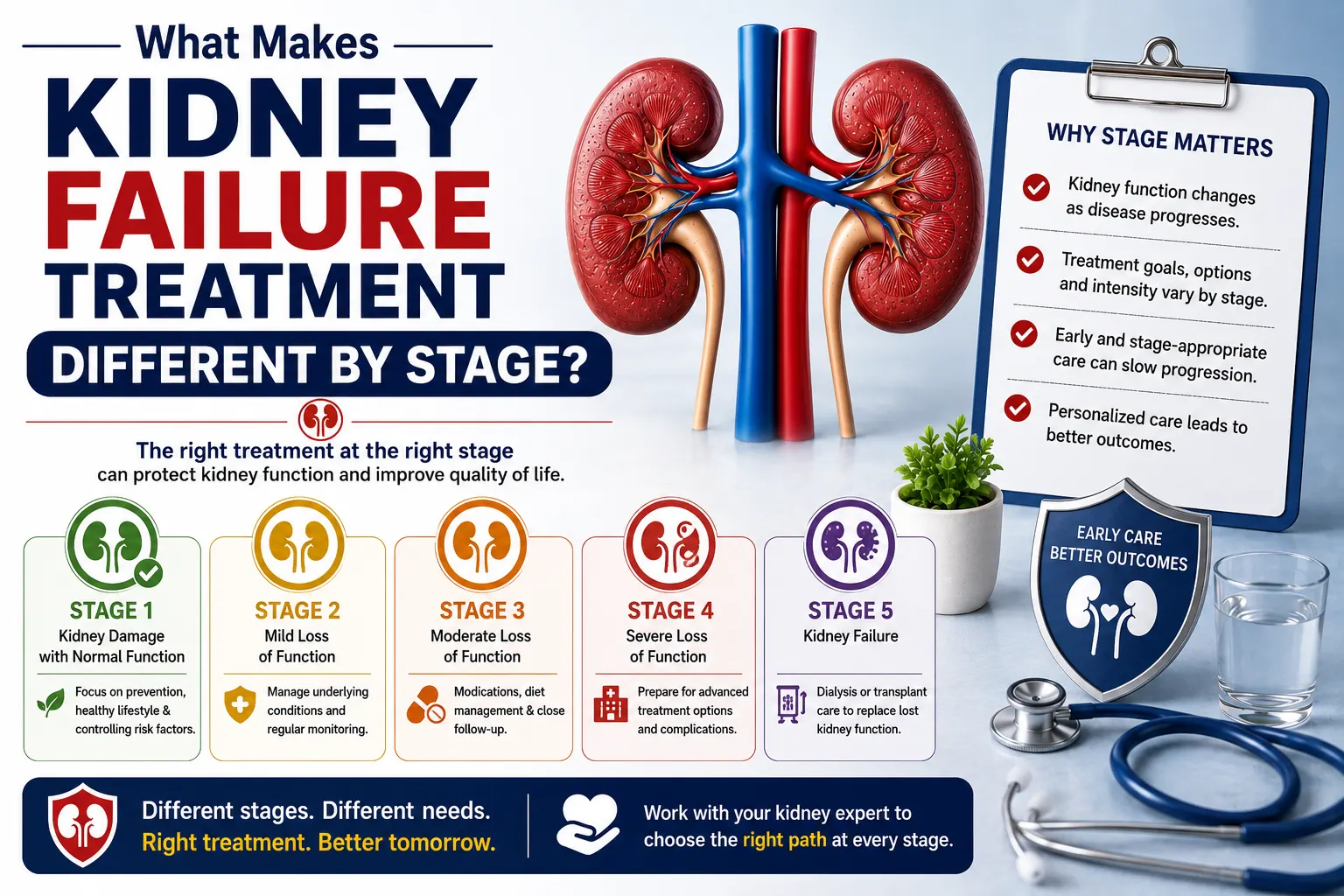

Kidney failure treatment changes drastically by stage because your kidneys shift from being slightly sluggish filters that need mild lifestyle adjustments to completely shutting down, requiring total mechanical or surgical replacement. Think of it like maintaining a car: in the early stages, you are just changing the oil and driving carefully; by the end, you are replacing the entire engine.
When you are dealing with a chronic kidney failure condition, understanding the roadmap is everything. Your kidneys; those two bean-shaped multitaskers quietly filtering your blood behind your ribs; don’t just give up overnight. They fade in stages, measured by your Estimated Glomerular Filtration Rate (eGFR), which is essentially a report card of how well your internal plumbing is working. Here is exactly how your kidney care strategy evolves as those numbers change, and why your medical game plan looks totally different at the start compared to the finish line.
📞 Get a Kidney Health Consultation – Call Now!
Early Stages: The "Wake-Up Call" (Stages 1 to 3)
In the beginning, your kidneys are like a slightly tired smartphone battery; not dead, but draining faster than you'd like. At this point, you probably won't feel a thing. Your kidney disease doctor will likely discover it during a routine blood test.
The goal here isn't to replace kidney function; it's to protect what you’ve got left. A landmark study known as the DAPA-CKD Trial showed that introducing specific medications, like SGLT2 inhibitors, early on can drastically slow down the decline of your kidney health.
-
The Vibe: Preemptive defense.
-
The Plan: Swapping your favorite salty chips for low-sodium alternatives, keeping a hawk-eye on your blood pressure, and managing your blood sugar if you have diabetes.
-
The Meds: ACE inhibitors or ARBs, which act like tiny umbrellas protecting your kidney's delicate filters from high blood pressure.
Stage 4: The "Brace for Impact" Strategy
When you transition to Stage 4, things get real. This is where your stage 4 CKD treatment officially steps up into high gear. Your filters are now operating at roughly 15% to 29% capacity. You might start feeling tired, notice your ankles swelling, or realize your food tastes a bit like metal.
At this juncture, treatment pivots from simple prevention to active damage control and intense future planning. According to the AHA/ACC/ASN Cardiovascular-Kidney-Metabolic Syndrome Guidelines, this is the critical window where your specialist starts preparing your body for what lies ahead.
-
Dietary Lockdown: You will work closely with a dietitian to strictly monitor your intake of potassium, phosphorus, and fluids.
-
The Packing List: Your doctor will start discussing "vascular access," which is essentially preparing a specific vein in your arm (an AV fistula) so it's healed and ready if you eventually need to start a machine-based treatment. It sounds intense, but it is the ultimate safety net.
📩 Ask a Kidney Expert (Free 10-Min Consultation)
Stage 5: Navigating Kidney Failure
Welcome to the end zone, medically known as End-Stage Renal Disease (ESRD). Your eGFR has dipped below 15, meaning complete kidney failure is either knocking on the door or already inside, making a mess.
This is where your CKD stage 5 treatment takes over. Because your kidneys can no longer sustain your life on their own, you have to choose a path to do the heavy lifting for them.
The Three Roads of Stage 5 Treatment:
-
Hemodialysis: You hang out at a clinic three times a week while a high-tech machine cleans your blood for you.
-
Peritoneal Dialysis: A clever home-based alternative where you use the lining of your own abdomen as a natural filter, allowing you to clean your blood while you sleep.
-
Kidney Transplant: The gold standard. A surgeon implants a healthy donor kidney, and you take daily medications to ensure your body welcomes its new roommate.
Summary of Treatment Shifts
Here is a quick look at how your daily routine changes as your kidneys advance through the stages:
|
Feature |
Stages 1–3 (Mild to Moderate) |
Stage 4 (Severe Decline) |
Stage 5 (Kidney Failure) |
|
Primary Goal |
Slow down the clock. |
Build a safety bridge. |
Active life support. |
|
Dietary Mood |
"Maybe skip the extra salt shaker." |
"Please carefully count your potassium milligrams." |
Strict fluid and chemical balances. |
|
Medical Team |
Your primary doctor + a friendly nephrologist. |
A very attentive kidney disease doctor. |
A whole squad of dialysis nurses and surgeons. |
Key Takeaways
-
Early Intervention Wins: Catching things in Stages 1–3 gives you the best shot at delaying advanced complications.
-
Stage 4 is for Planning: It's all about prepping your body and your veins for the next steps so there are zero emergencies.
-
Stage 5 Offers Options: Total kidney failure doesn't mean the end of the road; it just means picking the right replacement therapy (dialysis or transplant) that fits your lifestyle.
Frequently Asked Questions
Can I reverse stage 4 kidney damage?
While you cannot truly undo permanent scarring, the right treatment can drastically slow it down and keep you stable for years.
How long can you stay in stage 3 kidney disease?
With proper medication, an active lifestyle, and good blood pressure control, many people stay in Stage 3 for decades without ever advancing.
Does every person with stage 5 disease need dialysis?
Not necessarily; some skip dialysis entirely by getting a pre-emptive kidney transplant from a living donor.
What is the main cause of chronic kidney issues?
High blood pressure and diabetes are the two primary troublemakers responsible for most long-term kidney wear and tear.
Disclaimer
This article is written for educational and informational entertainment purposes only. Kidney health is highly complex, and clinical guidelines change frequently. Always consult a qualified medical professional or your personal physician before altering your diet, medication regimen, or treatment plan.