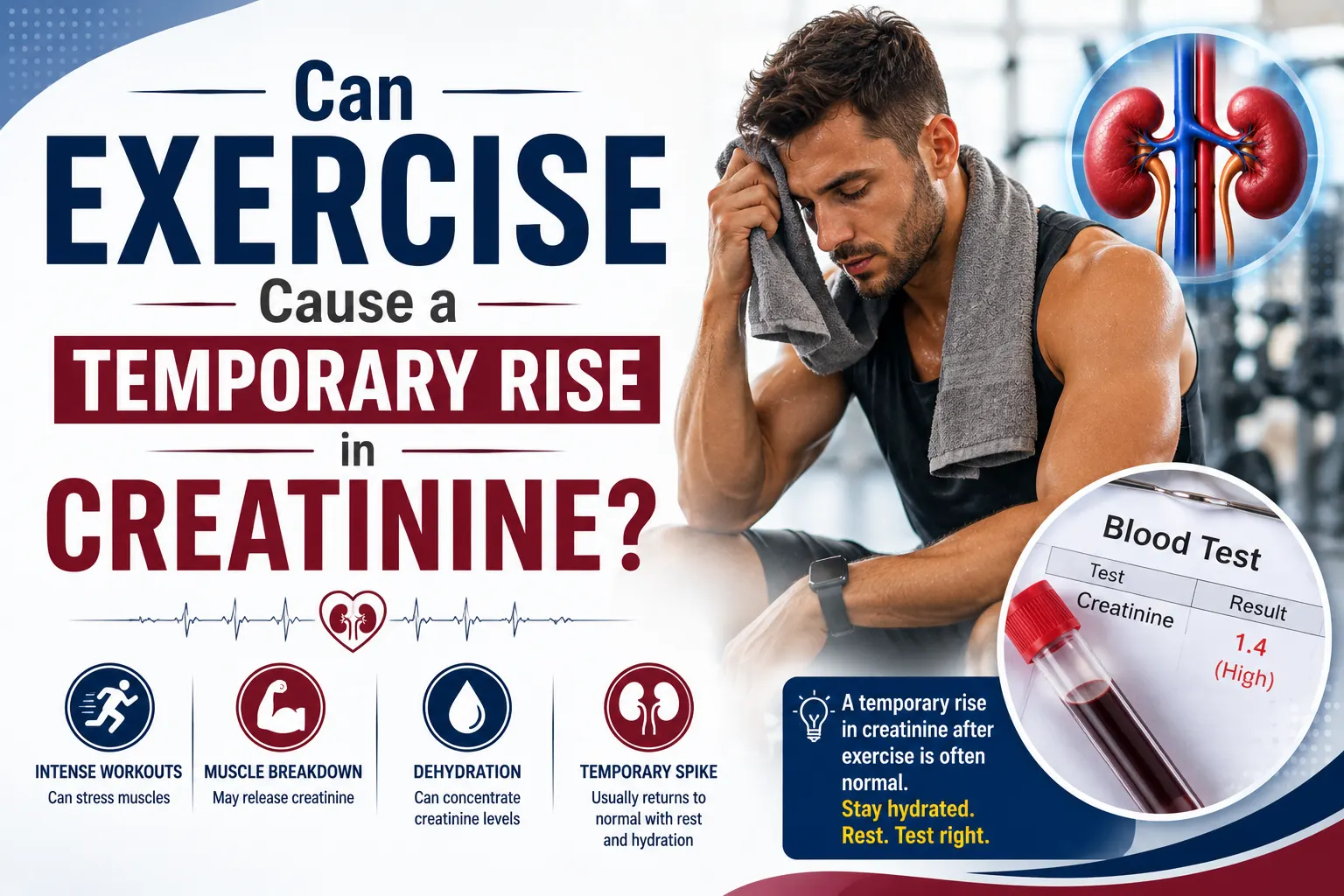

Short answer: yes, exercise can absolutely bump up your creatinine levels, and no, your kidneys aren't secretly failing on you. Nine times out of ten, it's just your muscles being a bit extra after a hard workout.
Okay, now let's actually get into it, because I know some of you clicked on this after staring at a lab report at 11 PM wondering if you need to start planning your funeral. Relax. Put the phone down. Breathe. I've been there too; got my bloodwork back after a heavy training week, saw "creatinine: slightly elevated," and immediately assumed the worst. Turns out I'd just deadlifted my body weight three days in a row and forgot to drink enough water. Classic me.
So, let's talk about what's actually going on here, minus the panic.
What Is Creatinine, Really?
Picture your muscles as a car engine. Every time they fire up- lifting, running, doing burpees you regret- they burn through a compound called creatine phosphate for fuel. And just like a car engine, that process leaves behind exhaust. That exhaust is creatinine.
Your kidneys' job is to filter this stuff out of your blood and send it packing through urine. This is exactly why doctors love checking serum creatinine; it's a decent proxy for how well your kidneys are filtering, something called your glomerular filtration rate (GFR). High creatinine usually gets flagged as "hey, kidneys might be struggling."
Except, and this is the part that gets left out of most panicked WebMD scrolling sessions, creatinine isn't only about your kidneys. It's also about how much muscle work you've been doing. More muscle activity, more exhaust in the tank. It's not rocket science; it's just... engine math.
Okay, But Why Does Working Out Spike It?
A few things happen when you push your body hard:
-
Your muscles break down more, which means more creatinine gets dumped into your bloodstream.
-
Blood gets redirected toward your working muscles and away from your kidneys; your body's basically saying "filtration can wait, we're busy surviving this HIIT class."
-
You sweat, you lose fluid, your blood gets more concentrated, and creatinine numbers look higher than they really are.
-
Your kidneys temporarily filter a little less efficiently mid-workout, so things pile up before they catch up later.
I'm not just making this up to sound smart. Researchers have actually chased marathon runners around with needles to prove it (bless their commitment to science). A study out of the Hartford Marathon, published in the American Journal of Kidney Diseases, found that <cite index="7-1">82% of runners developed an increase in creatinine level equivalent to AKIN-defined AKI stages 1 and 2</cite>, peaking the day after the race. Sounds alarming written out like that, I know; but this is temporary strain, not your kidneys quietly dying on the inside.
There's also a Berlin Marathon study that followed over 160 amateur runners, and get this: <cite index="4-1">30% showed a more than 25% decrease in cystatin C-estimated GFR from baseline right after the marathon</cite>, but here's the good part; <cite index="4-1">all cardiac and renal parameters returned to baseline within two weeks after the marathon</cite>. Your kidneys basically clock in for overtime, grumble about it, and then show up totally normal for their next shift. Very relatable, honestly.
And in one older but genuinely interesting study that tracked just six runners for days before and after a marathon, researchers noticed <cite index="2-1">creatinine clearance increased significantly 24 hours after the race, and reached its peak 3 days after the race</cite>. So your body isn't sitting there ignoring the spike; it's actively cleaning house afterward.
Is This Something to Actually Worry About?
For most healthy people, no. This is what's usually called exercise-induced creatinine elevation, and it's considered benign; a normal, expected response, not a red flag. Some researchers looking into ultramarathon runners have even pushed back on the idea that "exercise-induced kidney injury" should scare regular gym-goers at all, since the truly concerning cases tend to happen in extreme endurance events, not your average Tuesday leg day.
But, and there's always a but; this isn't a blanket pass for everyone. If you're already dealing with chronic kidney disease, diabetes, high blood pressure, or you're severely dehydrated while pushing yourself hard, a creatinine spike is worth more than a shrug. That situation deserves an actual conversation with your doctor, not a "eh, I read a blog about it once."
Muscle Mass Is Also Quietly Messing With Your Numbers
Here's something that confuses a lot of people: if you've got more muscle mass- bodybuilders, athletes, that one uncle who still benches every Thanksgiving before dinner; you'll likely have a naturally higher baseline creatinine level, even on a day you didn't work out at all. More muscle just means more exhaust-producing tissue sitting around.
So if you lift consistently and your creatinine looks a little high on a routine test, your doctor's first question is probably going to be "do you work out a lot?" before jumping to conclusions.
When Should You Actually Get Concerned?
|
Scenario |
Worry? |
Why |
|
Creatinine slightly high right after a tough workout |
Nah |
Muscles doing muscle things |
|
Numbers back to normal within 24–72 hours |
You're good |
This is the expected pattern |
|
Levels stay high for weeks |
Yeah, get it checked |
That's not a normal exercise response |
|
You already have kidney disease and train hard |
Yes, be careful |
Less filtration reserve to begin with |
|
You're dehydrated, dizzy, AND creatinine is up |
Yes, hydrate and get checked |
Could be real strain, not just noise |
|
You skipped the gym for a month, but creatinine's still high |
Also, worth a look |
Because now that's just suspicious |
A Few Practical Things That Actually Help
-
Drink water. Boring advice, I know, but dehydration is a huge reason numbers look scarier than they are.
-
Don't get bloodwork done right after a brutal workout. Give it a day or two to settle before you trust the number.
-
Build up your training gradually instead of going from zero to marathon in a week; your kidneys will thank you.
-
Mention your workout routine to your doctor before a kidney panel. Context genuinely changes how a lab result gets read.
-
Pay attention to real red flags: swelling, extreme fatigue, barely peeing, constant nausea. That's a different story than a normal post-workout blip.
Key Takeaways
-
Exercise-induced creatinine elevation happens often, especially after intense or long workouts like marathons.
-
It's mostly driven by muscle activity, shifted blood flow, and dehydration; not actual kidney damage.
-
Studies on marathon runners repeatedly show creatinine bouncing back within days to two weeks.
-
More muscle mass naturally means higher baseline creatinine; that alone isn't a warning sign.
-
Persistent elevation, dehydration symptoms, or existing kidney issues are the real reasons to get checked.
FAQs
Does exercise permanently damage your kidneys?
No, for most healthy people it's a temporary bump that resolves with rest and water, not lasting damage.
How long does it take creatinine to go back to normal after working out?
Usually a day or two, though something extreme like a marathon can take closer to two weeks.
Should I get bloodwork done right after exercising?
Better to wait at least 24 to 48 hours so the reading actually reflects your normal baseline.
Can being dehydrated make creatinine look worse than it is?
Yes, dehydration concentrates your blood and can make the number look higher than it really is.
Is high creatinine always a kidney problem?
Not necessarily; it can just mean you've got more muscle or recently worked out hard.
Disclaimer: This article is meant for general information, not medical advice. Everyone's body and kidney health are different, so if you're genuinely worried about your creatinine levels or kidney function, please talk to an actual doctor instead of trusting a blog you found at midnight.