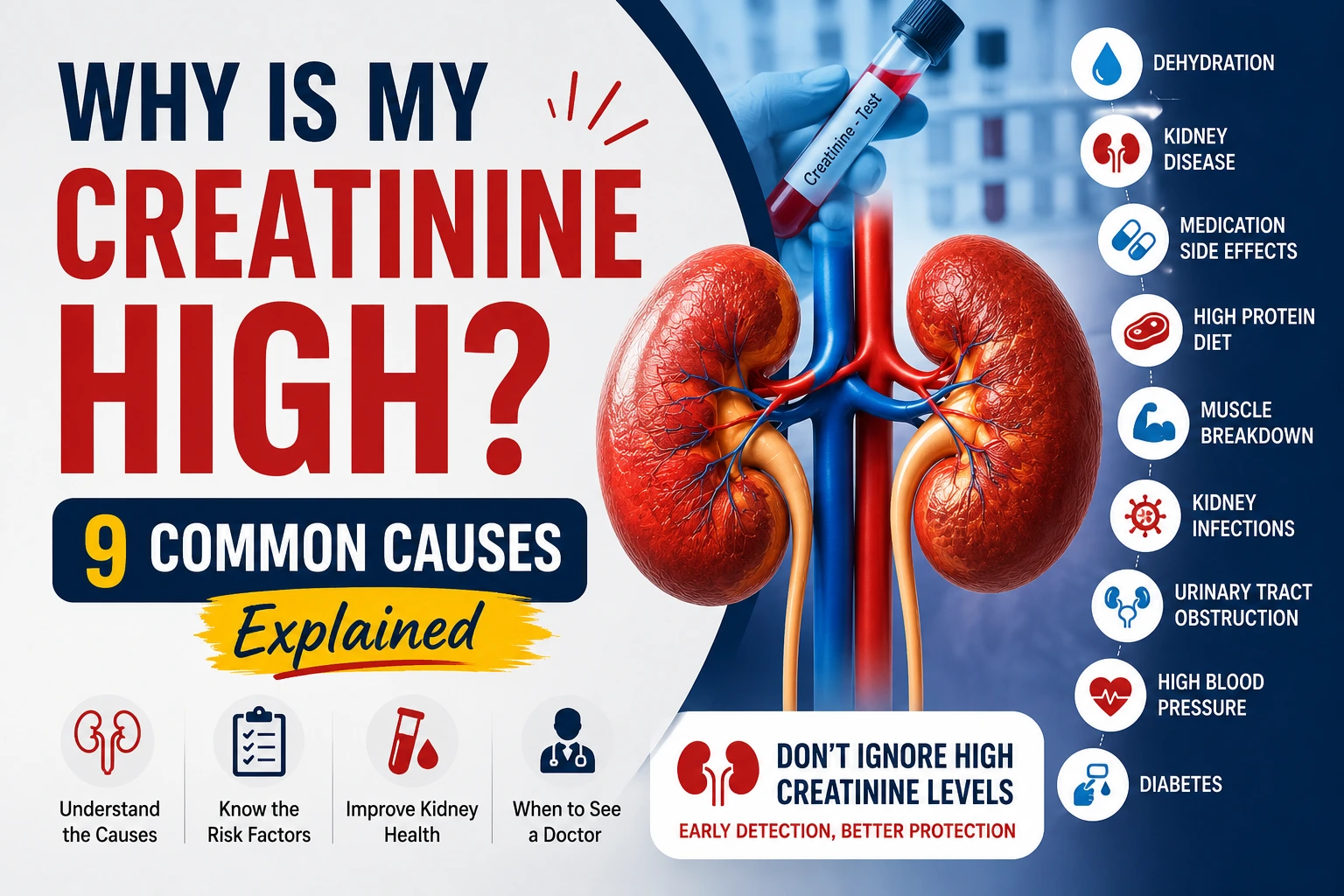

9 Common Causes Explained
So, your lab report came back, that one number is highlighted in red, and now you're sitting there Googling at 11 PM. First of all, breathe. High creatinine levels almost always mean your kidneys are filtering a little slower than usual at that exact moment; not that something is broken forever. The reasons range from boring stuff like "you didn't drink enough water" to "you ate a 16-ounce steak before your blood test" to, occasionally, something that genuinely needs a doctor's attention. This article walks through the nine most common reasons, in plain language, so you know what's worth worrying about and what's worth a shrug and a glass of water.
Key Takeaways
-
High creatinine does not always mean kidney disease; temporary factors can raise it too.
-
Dehydration is one of the most common causes of a mildly elevated creatinine level.
-
Heavy protein meals before a blood test can temporarily increase creatinine readings.
-
Intense exercise and muscle breakdown may cause short-term spikes in creatinine.
-
Creatine supplements can raise creatinine without harming kidney function in healthy people.
-
People with higher muscle mass often have naturally higher creatinine levels.
-
Certain medications, including NSAIDs, can affect kidney function and creatinine levels.
-
Kidney stones, urinary blockages, acute kidney injury, and chronic kidney disease may also increase creatinine.
-
A single high reading is not a diagnosis; repeat testing and medical evaluation are important.
What Creatinine Actually Is
Creatinine is a waste product made when your muscles use energy. Your kidneys' whole job is to filter it out of your blood and send it packing in your urine. When creatinine builds up in your blood instead of leaving, it usually means one of two things: either your kidneys are working a bit slower than usual, or your body is simply producing more of it than normal. Both situations can push the number up, and they are not the same thing at all.
A "normal" creatinine range is roughly 0.6 to 1.2 mg/dL for men and 0.5 to 1.1 mg/dL for women, though every lab has its own cutoffs, so don't panic over being 0.1 above some number on a chart.
9 Common Causes of High Creatinine Levels
Some of the major elevated creatinine causes are:
1. You're Dehydrated
This is, by far, the most common reason for a mildly elevated reading, as dehydration and creatinine share a strong bond. Less water in your blood means everything in it, including creatinine, looks more concentrated; kind of like how orange juice tastes stronger with less water mixed in. Doctors often look at the ratio between BUN (blood urea nitrogen) and creatinine to spot this pattern, since dehydration tends to push BUN up faster than creatinine.
-
Pointer: if you skipped water before your blood draw, ask to retest after a day of normal hydration before assuming the worst.
2. You Ate a Lot of Protein Recently
That post-gym chicken breast mountain or steakhouse dinner the night before your test can genuinely nudge your creatinine reading upward, since meat itself contains creatine and creatinine. Juraschek et al. (2013), in an ancillary analysis of the OmniHeart Trial conducted at Johns Hopkins, fed 164 healthy adults different diets for six weeks at a time and found that a higher-protein diet was linked to changes in kidney filtration markers, though it actually improved measured filtration rate rather than damaging it in healthy people. Long-term high protein intake is a separate, more nuanced conversation; but a single protein-heavy meal before a test is rarely cause for alarm.
-
Pointer: most labs ask you to avoid heavy meat consumption for 24 hours before a creatinine test for exactly this reason.
3. You Just Did Something Physically Intense
Marathon runners, CrossFit enthusiasts, and anyone who just discovered leg day exists are all prone to temporary creatinine spikes. Muscle breakdown from hard exercise releases extra creatinine into the bloodstream. Fitzpatrick and colleagues (2020), in a nine-year study of runners at the Brighton Marathon published in the European Journal of Emergency Medicine, found that a majority of runners showed creatinine above the normal range immediately after the race; whether or not they collapsed; and that levels returned to normal within 24 hours in almost everyone.
-
Pointer: if you exercised hard within 24–48 hours of your blood test, mention it to your doctor before jumping to conclusions.
4. You Take Creatine Supplements
Creatine monohydrate is one of the most popular gym supplements around, and it gets metabolized into, you guessed it, creatinine. This can raise lab numbers without actually reflecting reduced kidney function. Lugaresi et al. (2013), in a 12-week randomized, placebo-controlled trial published in the Journal of the International Society of Sports Nutrition, found that creatine supplementation did not impair actual kidney filtration in healthy, resistance-trained adults already eating a high-protein diet, even though creatinine numbers shifted.
-
Pointer: tell your doctor if you're supplementing, so the number can be read in context rather than in a vacuum.
5. You Simply Have More Muscle Than Average
Creatinine production is roughly proportional to muscle mass. Bodybuilders, athletes, and generally muscular people tend to run slightly higher creatinine than someone with less muscle; this is normal biology, not a red flag. It's also part of why creatinine-based kidney function estimates can be a bit imprecise for very muscular or very frail people, and why doctors sometimes use a different marker, cystatin C, for a clearer picture.
-
Pointer: if you've always run "slightly high" on this test and your kidneys otherwise check out fine, this might just be your baseline.
6. Certain Medications Are Involved
A handful of common drugs can raise creatinine, either by genuinely stressing the kidneys or by interfering with how creatinine is measured. NSAIDs (ibuprofen, naproxen) are repeat offenders here because they can reduce blood flow to the kidneys. Gooch et al. (2007), in a study of an elderly community-based cohort published in the American Journal of Medicine, found that regular NSAID use, especially COX-2 inhibitors, was associated with faster progression of existing kidney disease. Other culprits include certain antibiotics, some blood pressure medications (like ACE inhibitors, ironically often prescribed to protect kidneys), and diuretics.
-
Pointer: never stop a prescribed medication on your own because of a lab number; talk to your doctor first, since some of these effects are expected and monitored on purpose.
7. Urinary Tract Obstruction
Kidney stones, an enlarged prostate, or other obstructions can physically prevent urine (and the creatinine in it) from leaving the body properly. This tends to come with other symptoms too, like pain, reduced urine output, or difficulty urinating, rather than showing up as a silent lab finding alone.
-
Pointer: if you're noticing pain, swelling, or changes in urination alongside the high reading, that combination is worth a prompt doctor's visit rather than a wait-and-see approach.
8. You Have an Acute Kidney Injury
This is a sudden, often short-term drop in kidney function, frequently triggered by severe dehydration, a major infection, low blood pressure, or a reaction to certain drugs or contrast dye used in imaging scans. Unlike the mild bumps from exercise or diet, this tends to show a sharper, faster rise in creatinine and usually comes with feeling genuinely unwell.
-
Pointer: this one is generally not a "wait it out" situation; sudden, significant jumps in creatinine alongside symptoms like reduced urination, swelling, fatigue, or confusion deserve urgent medical attention.
9. You May Have Chronic Kidney Disease
This is the one everyone's brain jumps to first, and while it's worth taking seriously, it's also usually a gradual process diagnosed with more than one test over time, not a single number on one report. Chronic kidney disease tends to develop slowly, often linked to long-term diabetes or high blood pressure, and is typically confirmed through repeated testing, a calculated eGFR, and sometimes imaging or urine tests, rather than one isolated reading.
-
Pointer: one slightly high number is not a diagnosis. A pattern of consistently elevated readings over weeks or months, evaluated by a doctor, is what actually matters.
Quick Reference Table: Creatinine Causes At a Glance
|
Cause |
Usually Temporary? |
What Tends to Help |
|---|---|---|
|
Dehydration |
Yes |
Rehydrate, retest after a day |
|
High protein meal before test |
Yes |
Avoid heavy meat 24 hrs before testing |
|
Intense exercise |
Yes |
Rest, recheck after 1–2 days |
|
Creatine supplements |
Often, with normal kidney function |
Mention supplement use to your doctor |
|
Naturally high muscle mass |
It's your baseline, not a spike |
Track your personal normal over time |
|
Certain medications |
Depends on the drug |
Never self-stop; ask your doctor |
|
Urine flow blockage |
No, needs treatment |
Prompt medical evaluation |
|
Acute kidney injury |
No, needs urgent care |
Same-day or emergency medical care |
|
Chronic kidney disease |
No, needs ongoing management |
Repeated testing and a nephrology referral |
The Bottom Line
A high creatinine reading is a clue and can be one of the early kidney disease symptoms, not a verdict. It can be triggered by something as harmless as a workout or a steak dinner, or it can be your body waving a flag about something that needs real medical attention. The honest, unglamorous answer is: don't self-diagnose from one lab value, don't panic, and don't ignore it either; bring the full picture (your diet, your workouts, your medications, and how you're feeling) to a doctor who can actually connect the dots.
Disclaimer: This article is for general information only and isn't a substitute for individual medical advice. If you have concerns about a lab result, please talk to a qualified healthcare provider or visit Karma Ayurveda USA.
📩 Ask a Kidney Expert (Free 10-Min Consultation)
FAQ
What causes creatinine to rise suddenly?
A sudden rise in creatinine can result from dehydration, kidney infections, certain medications, blocked urine flow, or a sudden drop in kidney function.
Can dehydration increase creatinine?
Yes, dehydration can temporarily raise creatinine levels because the kidneys receive less blood flow and filter less efficiently.
What foods raise creatinine levels?
Large amounts of red meat, protein supplements, and cooked meat can temporarily increase creatinine levels in some people.
Is high creatinine reversible?
Sometimes yes; if the cause is temporary, such as dehydration or a medication side effect, creatinine levels may return to normal after treatment.