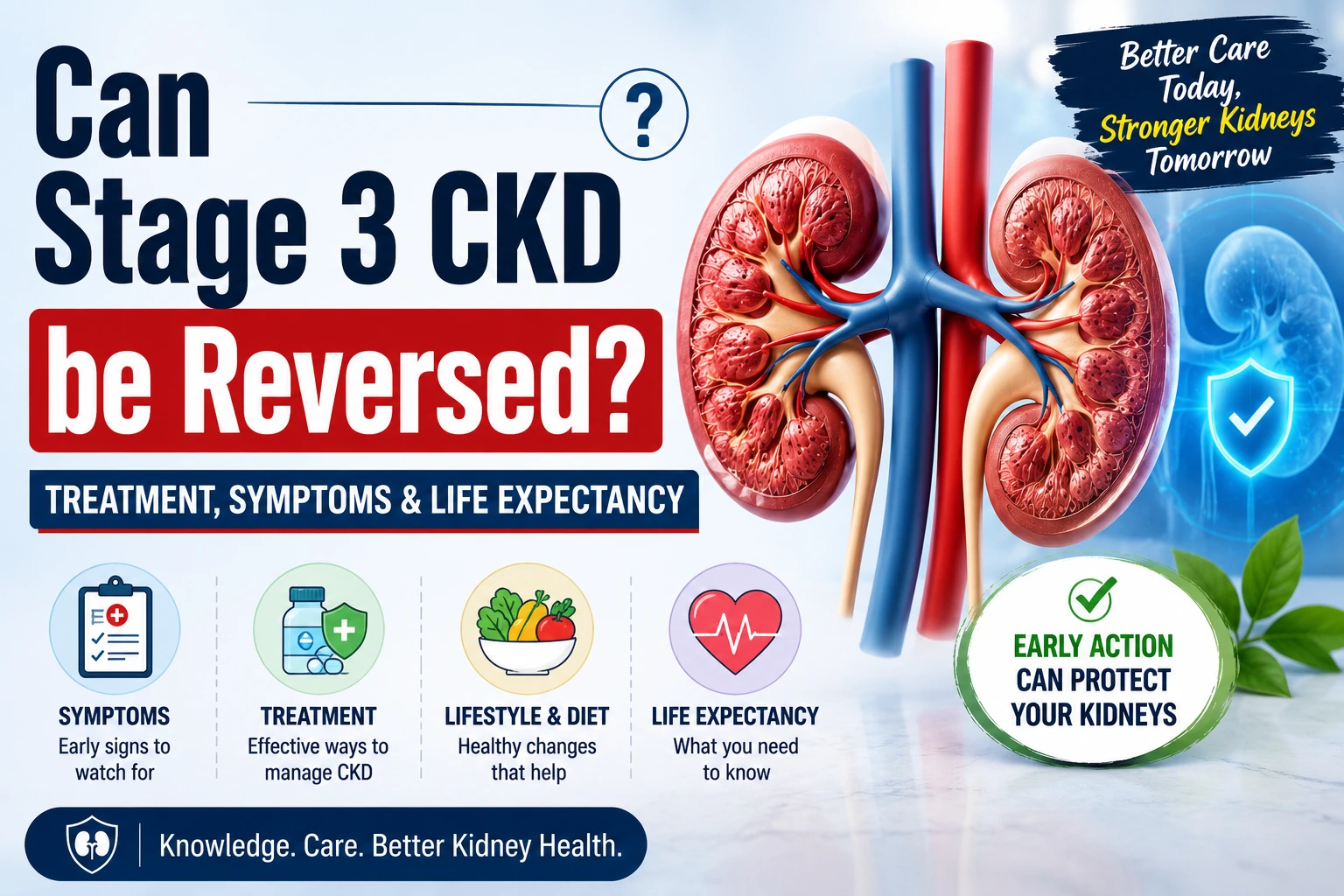

If you’ve recently been told you have Stage 3 chronic kidney disease (CKD), your first instinct was probably to panic-search the internet until you convinced yourself you’re basically a sentient raisin. Take a deep breath. You aren’t a raisin. You’re more like a high-end coffee machine that’s just a little overdue for a descale. Many people immediately wonder, can stage 3 CKD be reversed or at least controlled enough to live normally again?
The million-dollar question, the one that likely brought you here, is: "Can I reverse this, or am I stuck with kidneys that are lazier than a teenager on a Saturday morning?"
The honest, scientific answer is: It’s complicated, but there is a massive amount of hope.
What Exactly Is Stage 3 CKD? (And Why Do I Have Two Beans?)
First, let’s talk about your kidneys. They are two bean-shaped organs sitting in your lower back. Their main job is to filter your blood, manage your blood pressure, and make sure your body isn't holding onto more waste than a landfill.
Doctors measure how well these beans are working using a number called the GFR (Glomerular Filtration Rate). Think of your GFR like a credit score for your kidneys.
• Stage 1 & 2: Your kidneys are basically overachievers.
• Stage 3: This is the "Yellow Light" of kidney health. Your GFR is between 30 and 59. It means your filters are working at about half-capacity. This is also the point where many people begin noticing stage 3 kidney disease symptoms like swelling, fatigue, changes in urination, or high blood pressure.
• Stage 4 & 5: This is where things get serious, involving dialysis or transplants.
Stage 3 is actually the "sweet spot" for intervention. It’s the universe giving you a polite (if slightly annoying) tap on the shoulder, saying, "Hey, maybe put down the extra-large fries and let’s talk." This is why early-stage 3 kidney disease treatment matters so much.
The "R" Word: Can It Be Reversed?
In the strict medical sense, "reversing" implies that the scarred tissue in the kidney miraculously turns back into brand-new, baby-smooth tissue. Science hasn't quite figured out how to do that yet. However, and this is a big "however," you can significantly improve your kidney function and, in many cases, move your GFR back up into the Stage 2 range.
That’s why people often ask again and again, can stage 3 CKD be reversed naturally with the right lifestyle changes? More importantly, you can stop the progression. If you stay at Stage 3 for the next 40 years, guess what? You’ve won the game. The goal isn't just "reversal"; it's "stability."
The Secret Sauce: How to Befriend Your Kidneys
If you want to give your kidneys a fighting chance, you have to stop treating them like a rented mule. Here are the pillars of managing Stage 3 CKD in the US today and ways to improve kidney function naturally.
1. Taming the "Silent Killers"
High blood pressure and diabetes are the two biggest bullies in the kidney world. If your blood pressure is high, it’s like trying to garden with a fire hose; the pressure eventually shreds the delicate filters in your kidneys.
• Scientific Study: The SPRINT Trial (Systolic Blood Pressure Intervention Trial) showed that aggressive blood pressure management (getting that top number below 120) significantly reduced the risk of kidney function decline and cardiovascular events.
Controlling these conditions is one of the best ways to stop kidney disease progression before it reaches advanced stages.
2. The "Less is More" Protein Strategy
Your kidneys have to process protein waste. If you’re eating a 24-ounce steak every night, your kidneys are essentially working overtime without holiday pay. Shifting toward a more plant-based approach (or just eating smaller portions of high-quality protein) gives your kidneys a much-needed break.
Many patients exploring stage 3 CKD treatment naturally focus heavily on diet because food can either help your kidneys relax or make them file a workplace complaint.
• Scientific Study: The Modification of Diet in Renal Disease (MDRD) Study explored how varying levels of protein intake affect kidney decline, suggesting that moderate protein intake can help slow the progression of the disease.
3. Watch the Salt, Please
Sodium makes you retain water, which raises your blood pressure. In the US, our food is basically a salt lick. Reading labels is your new hobby. If a frozen dinner has 1,200mg of sodium, put it back and walk away slowly. Your kidneys will thank you.
Reducing sodium is also one practical step people take when trying to avoid dialysis naturally and protect their remaining kidney function.
4. Ditch the NSAIDs
This is a big one. Over-the-counter painkillers like Ibuprofen and Naproxen (Advil, Aleve) are like kryptonite for the kidneys. They reduce blood flow to the organs. If you have Stage 3 CKD, these should generally be off-limits unless your doctor says otherwise. Stick to Tylenol (Acetaminophen), but even then, keep it moderate.
New Medical Frontiers: The SGLT2 Revolution
For a long time, doctors didn't have many "magic bullets" for CKD. That changed recently with a class of drugs called SGLT2 inhibitors. Originally made for diabetes, scientists realized these drugs are essentially a spa day for the kidneys.
• Scientific Study: The DAPA-CKD Trial found that Dapagliflozin significantly lowered the risk of declining kidney function and reached "landmark" status for how we treat CKD today, regardless of whether the patient has diabetes or not.
If you aren't talking to your doctor about these new medications, you’re missing out on some of the coolest science since we put a rover on Mars.
The Psychology of the Diagnosis
Living with Stage 3 CKD can feel like walking around with a ticking clock in your pocket. But here’s a secret: millions of Americans are in Stage 3 and don't even know it. Because you do know, you have the power to act.
It’s not about living a life of deprivation. It’s about "strategic upgrades." Swap the soda for sparkling water. Swap the salt shaker for some lemon and garlic. Take a 20-minute walk while listening to a podcast about 18th-century pirates. These small things add up to big wins for your GFR.
Pay attention to the signs kidneys are getting worse, such as swelling in the legs, severe fatigue, worsening blood pressure, shortness of breath, or changes in urination. Catching these warning signs early can make a huge difference.
Actionable Steps for Your Next Doctor’s Visit
Don't just sit there while your doctor mumbles about "creatinine levels." Be the CEO of your own body. Ask these questions:
• What is my exact GFR, and how has it changed over the last three tests?
• Is my blood pressure consistently under 130/80?
• Are there any medications I’m taking (like certain acid reflux meds or NSAIDs) that are hurting my kidneys?
• Am I a candidate for SGLT2 inhibitors or ACE inhibitors/ARBs?
• Can I get a referral to a renal dietitian? (These people are wizards with food.
The Bottom Line
Is Stage 3 CKD a "death sentence" for your kidneys? Absolutely not. Is it a permanent tattoo? Not necessarily. While "total reversal" is a tricky term, "significant improvement" and "long-term stability" are very much on the menu.
Your kidneys are resilient little beans. They’ve been working hard for you since before you could walk. If you give them a little less salt, a little less pressure, and a lot more water, they might just surprise you by bouncing back better than a 90s fashion trend.
Focus on what you can control. Eat your veggies, take your meds, and stop Googling "kidney transplant" at 3 AM and consult an expert like Dr. Puneet Dhawan in case the symptoms are severe. You’ve got this. Your kidneys are rooting for you, mostly because they live inside you and want to keep their jobs, but hey, support is support!
FAQ
Q: Can your kidneys recover from stage 3 kidney disease?
A: They can’t fully reverse, but proper care can slow progression and improve function.
Q: What is the life expectancy with stage 3 CKD?
A: Many live normal lives with good management and healthy lifestyle changes.
Q: How long does it take for stage 3 CKD to progress to stage 4?
A: It varies widely, sometimes years, depending on treatment and lifestyle.
Q: Should I worry about stage 3a kidney disease?
A: It’s a warning sign; stay on top of diet, meds, and regular check-ups.