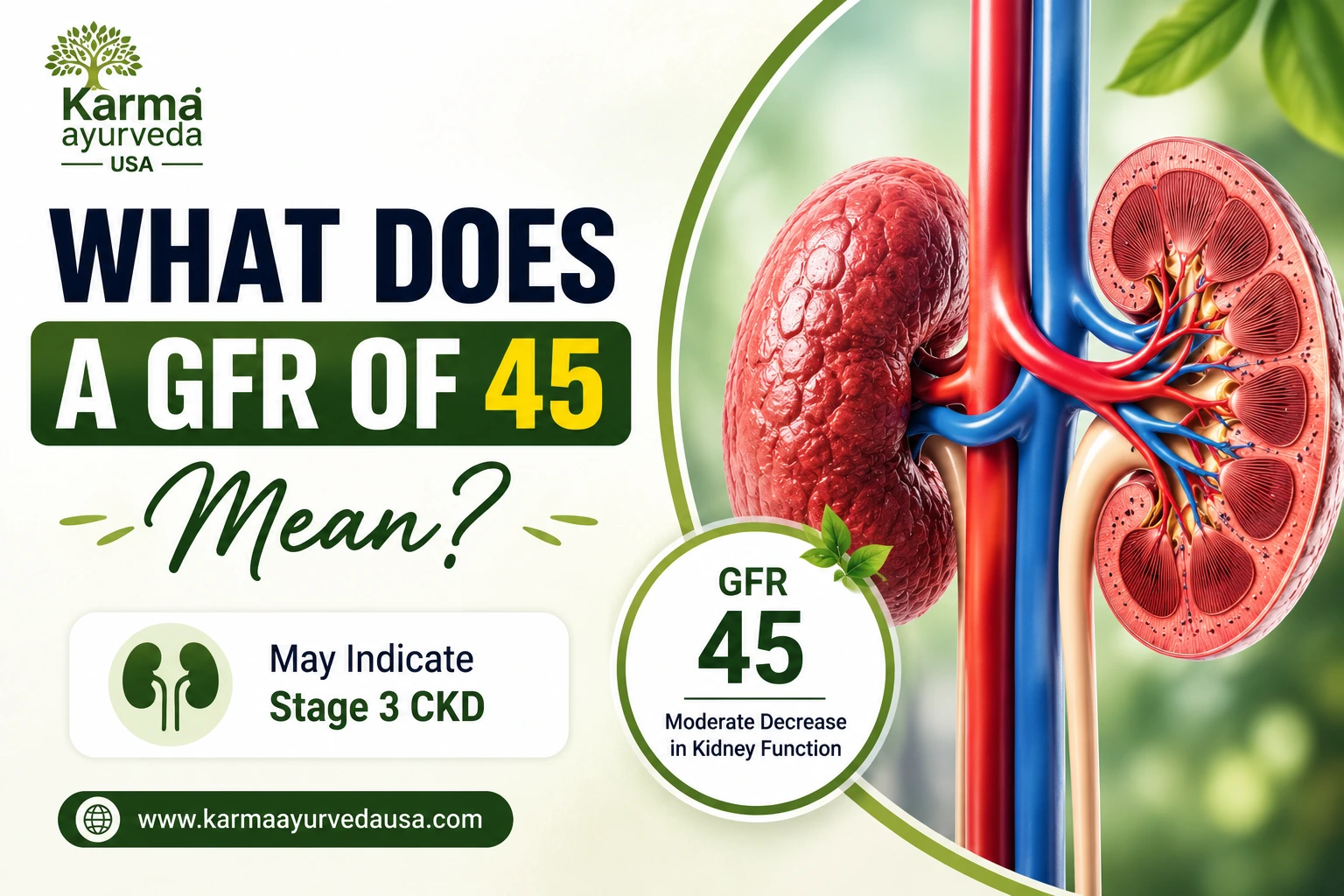

What Does a GFR of 45 Mean? A Friendly, No-Panic Guide
So, you got your lab report back, saw the number "45" sitting next to "GFR," and now you're here, at 11 PM, frantically typing into a search bar. First of all, breathe. Second of all, you're in good company, because this is one of the most Googled lab questions out there.
Here's the short, honest answer: GFR 45 means, in plain English, that your kidneys are working at roughly 45 percent of what's considered normal. That generally lines up with what doctors call chronic kidney disease stage 3a, which sits in the "okay, let's pay attention to this" zone; not an emergency, but not something to shrug off either. We'll unpack every bit of that in this article, minus the scary jargon and minus the doom-scrolling spiral.
The Quick Answer (For Those Who Just Want It)
-
A GFR of 45 means your kidneys are filtering blood at about 45% of the efficiency of healthy kidneys.
-
It typically falls under what's classified as Stage 3a kidney disease, a moderate stage.
-
It is not a diagnosis by itself; it's one piece of a bigger puzzle.
-
It usually calls for more testing, a chat with your doctor, and probably a few lifestyle tweaks.
-
It is not the same as kidney failure, so let's not jump there.
Now let's get into the "why" behind all of this.
What Even Is GFR? (Without the Textbook Headache)
Think of your kidneys as two incredibly committed, slightly obsessive bouncers standing at the door of a club called "Your Bloodstream." Their job is to check every single guest (blood) and decide what stays and what gets kicked out (waste, extra fluid, toxins). The kidney filtration rate is a measure of how quickly and effectively these bouncers are doing their job.
In medical terms, this is called the estimated glomerular filtration rate, or GFR for short. It tells you how many milliliters of blood your kidneys can filter per minute. A healthy young adult typically clears around 90 to 120 mL/min. So, when someone says "GFR 45," they mean your kidneys are clearing blood at less than half that ideal pace.
This measurement matters more than people realize. A large pooled analysis of general population studies Matsushita et al., 2010, published in The Lancet and conducted by the Chronic Kidney Disease Prognosis Consortium) looked at over a million people and found that as GFR drops, the risk of health complications climbs steadily, independent of other factors. It's one of the reasons doctors take this single number so seriously.
Breaking Down the GFR Stages (Because Context Is Everything)
Numbers without context are like getting a test score without knowing the grading scale. Here's how the stages generally break down:
|
GFR Range (mL/min) |
Stage |
What It Roughly Means |
|---|---|---|
|
90 and above |
Stage 1 |
Normal or high filtration, kidneys doing their bouncer job well |
|
60–89 |
Stage 2 |
Mildly reduced function, often age-related |
|
45–59 |
Stage 3a |
Mild to moderate dip, time to start watching closely |
|
30–44 |
Stage 3b |
Moderate to noticeable dip, more monitoring needed |
|
15–29 |
Stage 4 |
Severe reduction, specialist care usually involved |
|
Below 15 |
Stage 5 |
Kidney failure, dialysis or transplant discussions begin |
So, if your number is 45, you're sitting right at the edge between Stage 3a and Stage 3b; basically the "we caught this in time" zone. That table also explains why doctors don't panic at a single 45 reading; they look at the trend over months, not just one snapshot.
So What Does GFR 45 Actually Mean For You?
Here's where we get specific. An eGFR of 45 usually indicates moderate kidney damage. The "estimated" part matters; this number isn't measured by sticking a tiny ruler into your kidney (thankfully). It's calculated using your blood creatinine level, age, sex, and sometimes a second marker called cystatin C, plugged into a formula.
The most widely used formula today comes from Levey et al., 2009, published in the Annals of Internal Medicine, known as the CKD-EPI equation. It was later updated in Inker et al., 2021, in the New England Journal of Medicine, which refined the formula to remove race as a variable, making the estimate more equitable across different populations. So, when your lab report shows "eGFR," it's quietly running decades of research math in the background just to spit out one number.
Now, repeating ourselves a bit on purpose here because it's worth hammering home: the GFR 45 meaning isn't "your kidneys have given up." It means they're under more strain than they should be, and something- high blood pressure, diabetes, an infection, dehydration, or even certain medications- is likely contributing to the slowdown. The encouraging part is that Stage 3a is often a stage where lifestyle changes and medical management can actually slow things down or stabilize them.
Why One Number Isn't the Whole Story
If GFR were a movie, it would only be the trailer. Doctors almost always pair it with another test called the Albumin-to-Creatinine Ratio (ACR), which checks whether protein (specifically albumin) is leaking into your urine. Healthy kidneys are like good bouncers; they don't let valuable stuff like protein slip out by accident. If protein is showing up where it shouldn't, that's a sign the filtering units (called nephrons, if you want to impress someone at a dinner party) are getting a bit leaky.
The same Chronic Kidney Disease Prognosis Consortium data, this time from van der Velde et al., 2011, published in Kidney International, found that at a GFR around 45, the risk of death from any cause was about 1.38 times higher compared to someone with a GFR of 95; and that risk shifted even more depending on ACR levels. In other words, GFR and ACR work as a duo, not solo acts. One without the other is like judging a movie by its poster alone.
What a Doctor Typically Does Next
If your Kidney Function Test comes back showing a GFR of 45, here's roughly what tends to happen, though of course every case is different and only your own doctor can map out the right plan for you:
-
They'll likely repeat the test in a few weeks, because a single number can be thrown off by dehydration, recent intense exercise, certain medications, or even a big steak dinner the night before (creatinine comes from muscle and protein breakdown).
-
They may order the ACR test alongside it to get the fuller picture.
-
They'll review your blood pressure, blood sugar, and any existing conditions like diabetes or hypertension, since these are the most common contributors to reduced kidney function.
-
They might adjust medications that are hard on the kidneys.
-
They could suggest dietary tweaks, like watching sodium and protein intake, depending on your specific situation.
According to the KDIGO 2012 Clinical Practice Guideline for the Evaluation and Management of Chronic Kidney Disease, published by Kidney Disease: Improving Global Outcomes, both GFR and ACR levels together help classify risk far more accurately than either number alone, which is exactly why your doctor isn't just glancing at one lab value and calling it a day.
Common Questions People Ask About GFR 45
Is a GFR of 45 considered kidney failure? No. Kidney failure usually refers to Stage 5, where GFR drops below 15. A GFR of 45 is moderate, not failure.
Can a GFR of 45 improve over time? In many cases, yes, especially if the underlying cause (like blood pressure or blood sugar) is managed well. It's not guaranteed, but it's far from a one-way street.
Does GFR 45 mean I need dialysis? Not at this stage. Dialysis conversations typically start much later, around Stage 5, and only after a lot of monitoring and medical discussion.
Why did my GFR number change between two tests? GFR can fluctuate due to hydration, recent meals, medications, illness, or lab variability. That's exactly why doctors like to see a trend over repeat testing rather than reacting to one number.
The Bottom Line
A GFR of 45 is your body's way of waving a small flag, not setting off a siren. It generally signals moderate kidney strain and lines up with Stage 3a, a stage where attention, follow-up testing, and a good working relationship with your doctor genuinely make a difference. This article is meant to help you understand the number, not diagnose or treat anything; so if this result is sitting in your hands right now, the best next move is a calm, informed conversation with your healthcare provider, armed with the questions this article just gave you.
This article is for general educational purposes only and is not a substitute for professional medical advice, diagnosis, or treatment. Always consult your doctor or a qualified healthcare provider regarding your specific lab results and health condition.
Studies Referenced
-
Levey AS, et al. (2009); Annals of Internal Medicine; Development of the CKD-EPI equation for estimating GFR.
-
Matsushita K, et al. (2010); The Lancet; Chronic Kidney Disease Prognosis Consortium meta-analysis on eGFR, albuminuria, and mortality risk.
-
van der Velde M, et al. (2011); Kidney International; Collaborative meta-analysis on eGFR and albuminuria in high-risk population cohorts.
-
Inker LA, et al. (2021); New England Journal of Medicine; Development of race-free creatinine and cystatin C-based eGFR equations.
-
KDIGO (2012/2013); Kidney International Supplements; Clinical Practice Guideline for the Evaluation and Management of Chronic Kidney Disease.
FAQ
Is a GFR of 45 dangerous?
A GFR of 45 indicates moderate kidney damage (Stage 3 CKD) and should be monitored and managed with a doctor.
Can GFR 45 improve?
Yes, GFR can sometimes improve or stabilize if the underlying cause is treated and kidney-friendly habits are followed.
What foods help improve GFR?
A kidney-friendly diet with fruits, vegetables, whole grains, and low sodium may help support kidney function.
How long can you live with GFR 45?
Many people live for decades with a GFR of 45 by managing their kidney health and related conditions properly.